
.webp)
Manufacturing is the process of transforming raw materials into finished products through a series of organized steps. In this article, I’ll walk you through that process by following a fictional factory that produces plastic building blocks.
By the end of this article, you will be able to:
- Explain how a typical factory is laid out and why,
- Explain the steps involved in transforming raw materials into a finished product, and
- Understand the role that automation plays in each step of the manufacturing process
This will give you a good understanding of industrial manufacturing that all controls and automation engineers need.
Brick kits
Our fictional factory produces kits that are made up of a specific set of parts to produce a specific model. Each kit can contain hundreds of discrete plastic pieces. Each piece must be manufactured, sorted, and assembled correctly.
These pieces are grouped into plastic bags, and the plastic bags are packed into a cardboard box, which will eventually sit on the shelf in a store.
Not every component in a kit is made in-house. In our case, the plastic bricks are manufactured in-house, but other components, like the plastic bags, the printed boxes, and the instruction booklets, are purchased from external suppliers and delivered to the factory.
Once the kits are assembled, they are packed into a larger case, and the cases are stacked and secured on pallets for shipment to distributors and retailers.
Now that we know what is manufactured at the factory, let’s look at the process that is used for manufacturing.
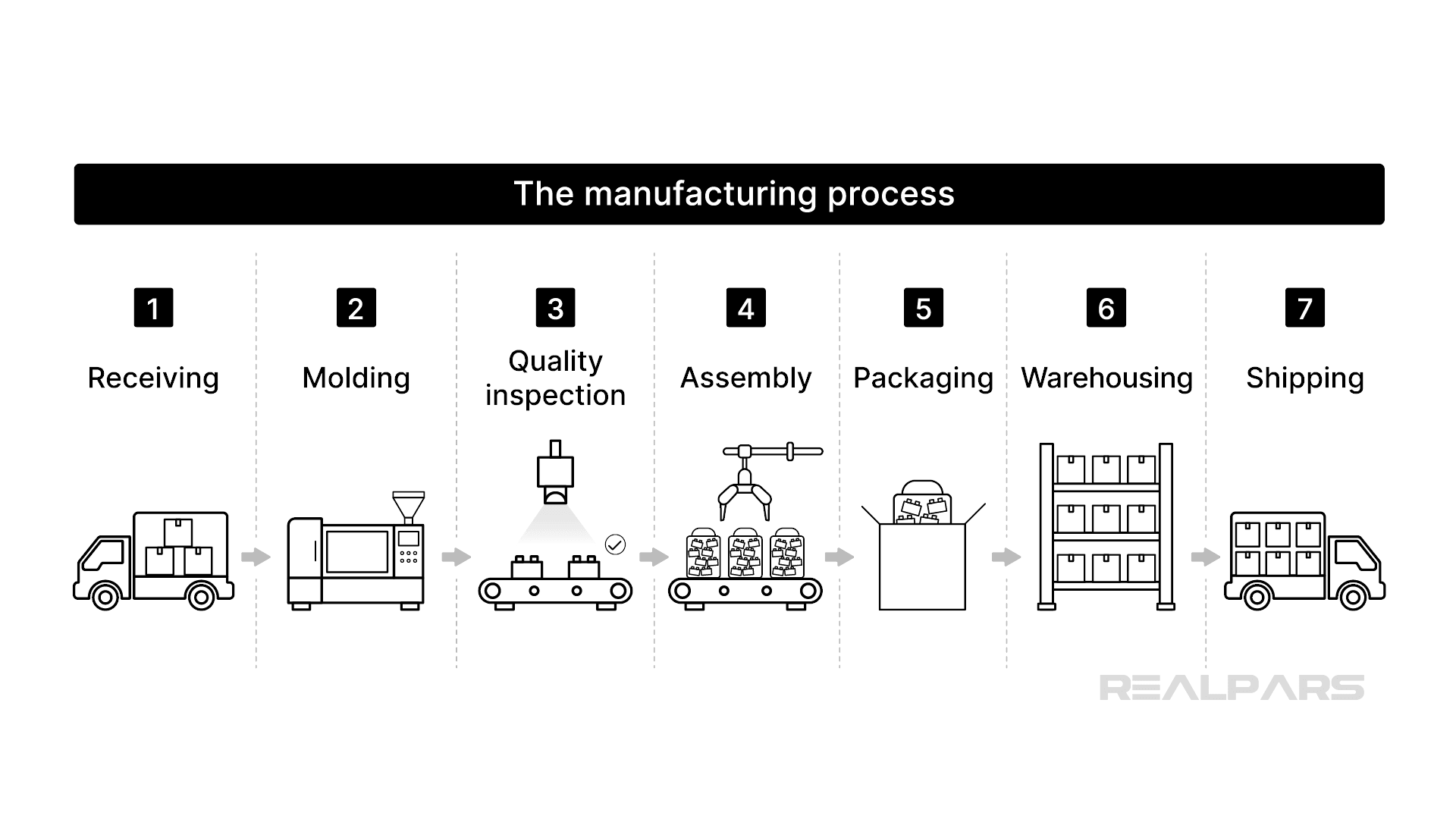
Manufacturing process
Receiving
The manufacturing process starts at the receiving dock.
Trucks back up to loading bays, and incoming materials are unloaded. Depending on the material and the volume, this can be done with a forklift or a conveyor system.
Forklifts are more flexible since they can handle irregular loads and move freely around the dock.
Conveyors offer higher throughput because they move material continuously without stopping, which makes them the right choice when you're unloading large, consistent volumes of the same item.
At our brick factory, the incoming materials include plastic granules and packaging supplies. Once received, each material is routed to the area of the factory where it's needed.
Molding
Plastic granules are sent to the molding area. Here, they are fed into injection molding machines that heat the granules and force the molten plastic into metal dies, which are metallic molds that determine the final shape of each piece.
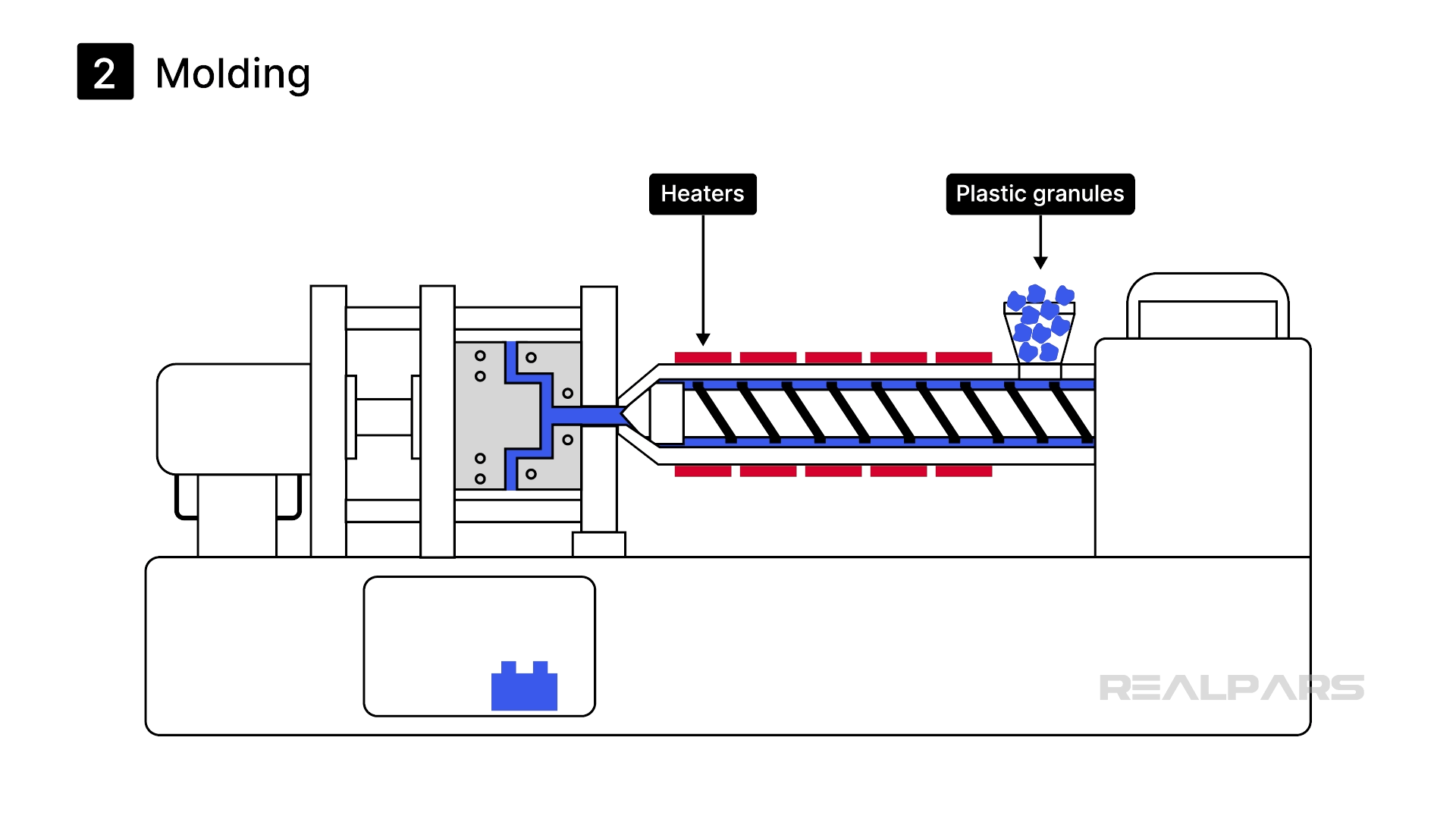
Different types of granules produce different colors and material properties.
Different dies produce different brick shapes and sizes.
By swapping granules and dies, the same molding machine can produce a wide variety of components.
Finished components come out of the molding machines and are collected into bins. Those bins are then transported to the assembly area.
Quality inspection
Before components move to assembly, they may go through an inspection step. This can be a manual process where a technician removes a sample of parts from a bin and visually checks the parts for defects, or an automated process where machine vision systems inspect each part against a specification. More and more of these systems now use AI. You can learn more in How to Use AI in Industrial Automation: Machine Vision.
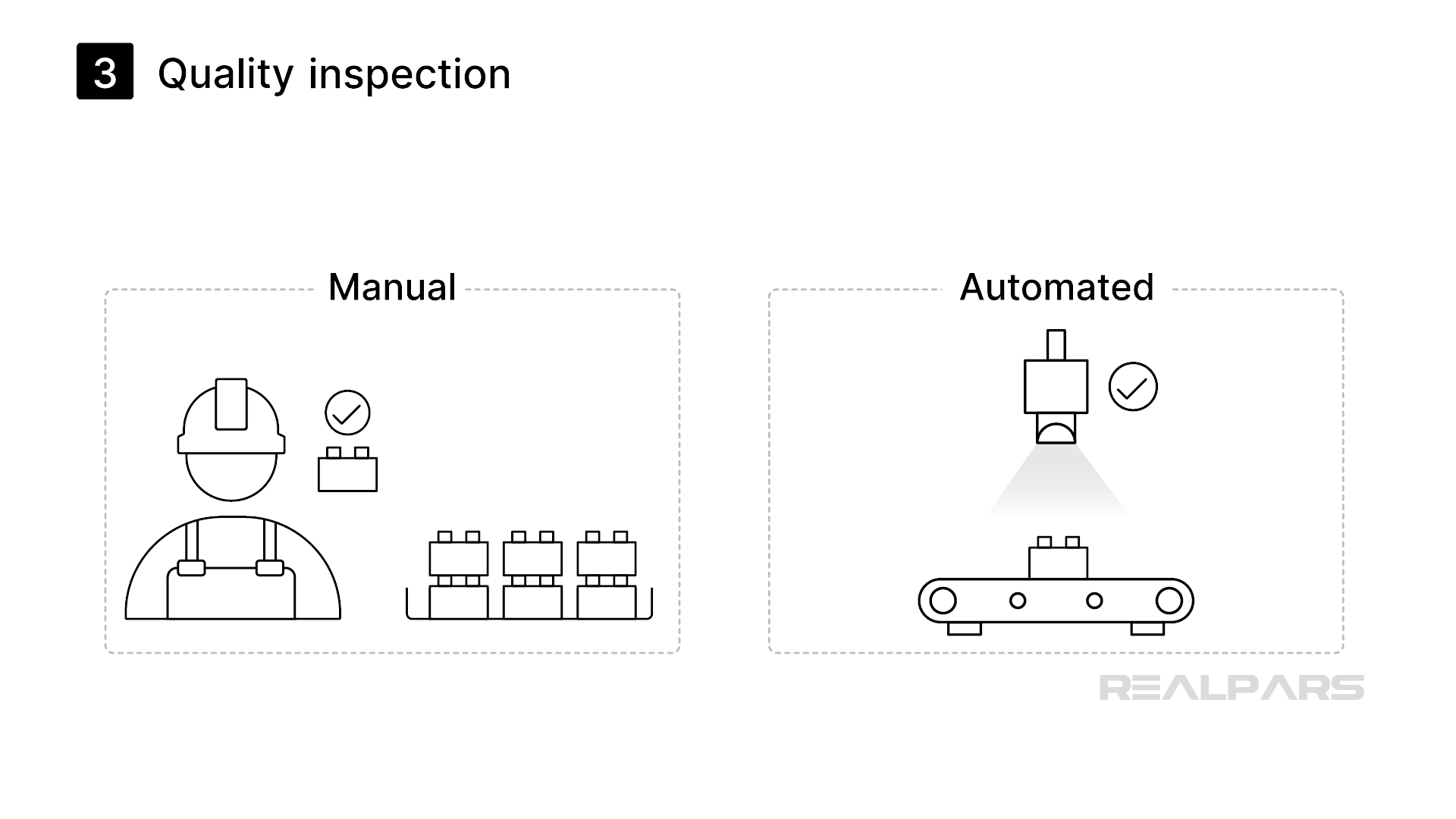
Automated inspection is faster and more consistent because it removes the possibility of human error.
Manual inspection is more flexible and easier to set up when the defect types are difficult to define in software.
Assembly
In the assembly area, components are combined into finished kits. The exact combination of parts that goes into each kit is defined by a Bill of Materials, or BOM. The BOM is essentially the recipe for that product that lists every component and quantity that has to be added to the kit.
Assembly can be manual or automated.
In a manual assembly line, workers pull components from bins and place them into bags according to the BOM.
In an automated assembly cell, robots perform the same pick-and-place operations.
The choice between manual and automated assembly depends on factors like production volume, part complexity, and the cost of automation relative to labor.
Packaging
After assembly, the process shifts to packaging. Bags of components are placed into printed cardboard boxes. Boxes are then packed into larger shipping cases. Cases are stacked onto pallets, and the pallets are wrapped in stretch film to secure the load for transport.
This sequence of packing goods into boxes, packing boxes into cases, and placing cases on pallets is common in consumer goods manufacturing.
Once again, this process can be manual or automated.
It is very common to see automated packaging lines because the boxes, cases, and pallets do not have a lot of variations and are easy to handle.
Warehousing and shipping
Once palletized, the finished goods move to the warehouse.
Pallets can be moved manually by forklifts or automatically.
Traditionally, automated pallet handling systems were made up of conveyors that transported pallets to an automated storage and retrieval system.
More recently, companies have started to use Automated Mobile Robots, or AMRs, which are intelligent forklifts that don’t require a driver. AMRs are typically more flexible than conveyor systems.
Pallets are stored in the warehouse until an order is placed, at which point the pallets are picked, loaded onto outbound trucks, and shipped to customers.
Wrap-Up
In this article, I walked you through a typical manufacturing process using a plastic brick factory as an example. Specifically, you learned:
- How raw materials are received and routed through a factory,
- How automated machines are used to manufacture intermediate products from raw materials,
- How intermediate products are assembled into a finished product,
- How finished products are packaged and palletized
This process applies to most manufactured goods. In the factory that produces them, raw materials arrive, they're transformed into components, components are assembled into a finished product, and that product is packaged and shipped.
One thing worth noting: all of the machines and processes in this factory, like the molding machines, the conveyors, and the assembly robots, are controlled by Programmable Logic Controllers, or PLCs. PLCs are the backbone of industrial automation.

