
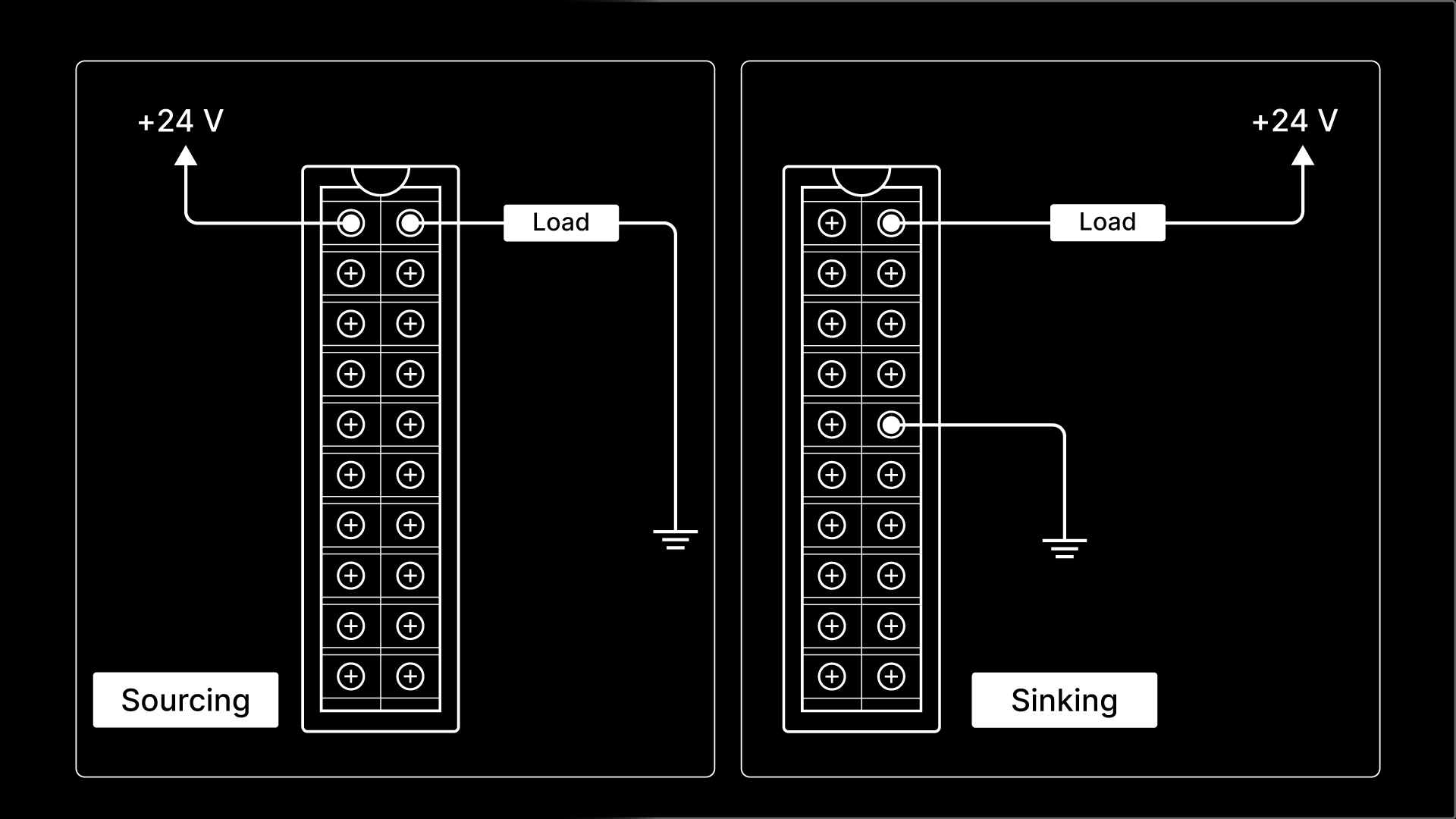
PLC system troubleshooting should begin by investigating the field devices and I/O modules, not the PLC program. 70–80% of faults originate with field devices and associated wiring, power supplies, and other related hardware. PLC program faults are rare unless someone has been making changes.
In this article, we’ll explain the characteristics of sinking and sourcing PLC outputs so you can effectively troubleshoot and identify the source of the fault.
Let’s start with the terms Sinking and Sourcing.
Sinking and Sourcing
Many of us were taught the truth that negative-to-positive electron current flow is a fact. When we talk about sinking and sourcing, we refer to positive-to-negative current flow, which is conventional current flow.
Why is conventional current terminology used to describe sinking and sourcing? It’s about tradition, as concepts and standards were established long before electrons were understood.
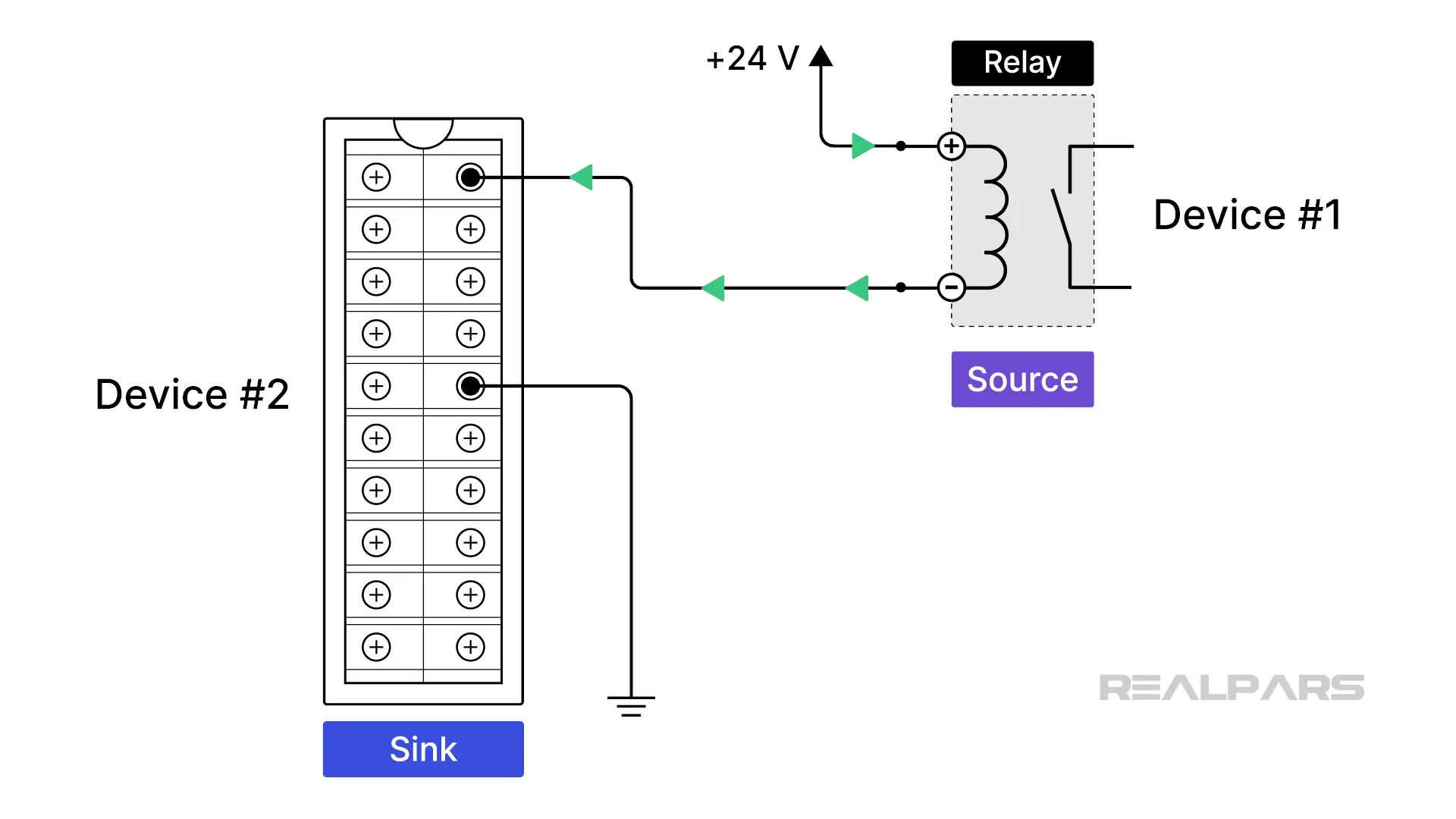
If current is flowing from Device #1 to Device #2, Device #1 is sourcing the current, and Device #2 is sinking the current.
Suppose Device #1 is an output field device, such as a relay coil, and Device #2 is a PLC digital output module. If current flows from the relay coil to the output module, the relay coil is the source and the output module is the sink.
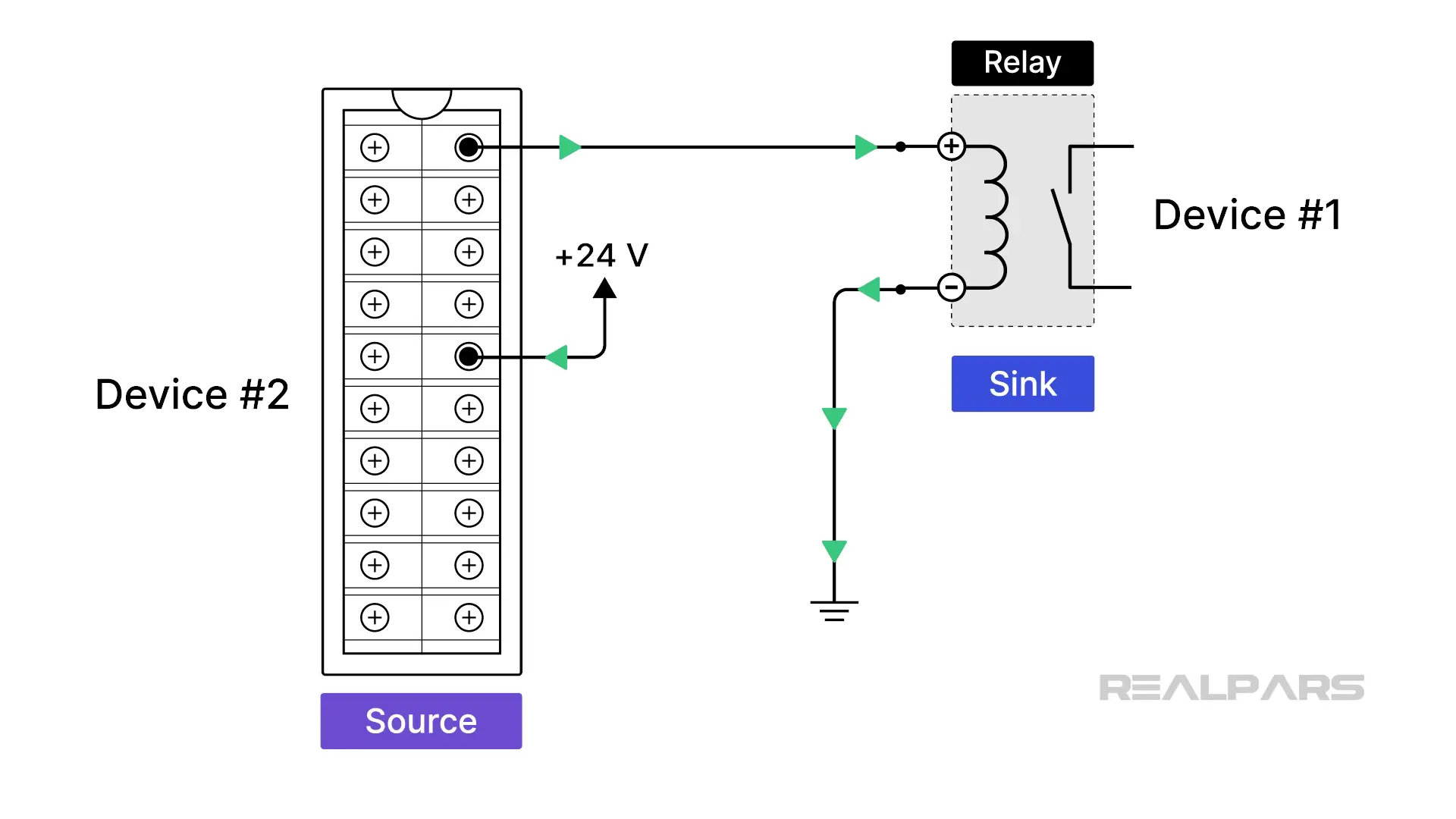
If current flows from the output module to the relay coil, then the module is the source, and the relay coil is the sink.
Output module types
PLC vendors offer both solid-state sinking and sourcing output modules. The actual switching action is performed by solid-state components, typically BJTs or FETs, which turn the load voltage on or off electronically.
Because of solid-state switching, the current flow direction matters when matching the module to the type of field device being controlled.
The dry relay is a third type of output module. It was the original standard for fixed PLC I/O, using mechanical contacts that switch AC and DC loads regardless of polarity or current direction.
On many PLCs, you can hear the relay contacts click closed. The dry relay output module can act as a sink or a source. It remains popular today in applications with mixed load types or higher currents.
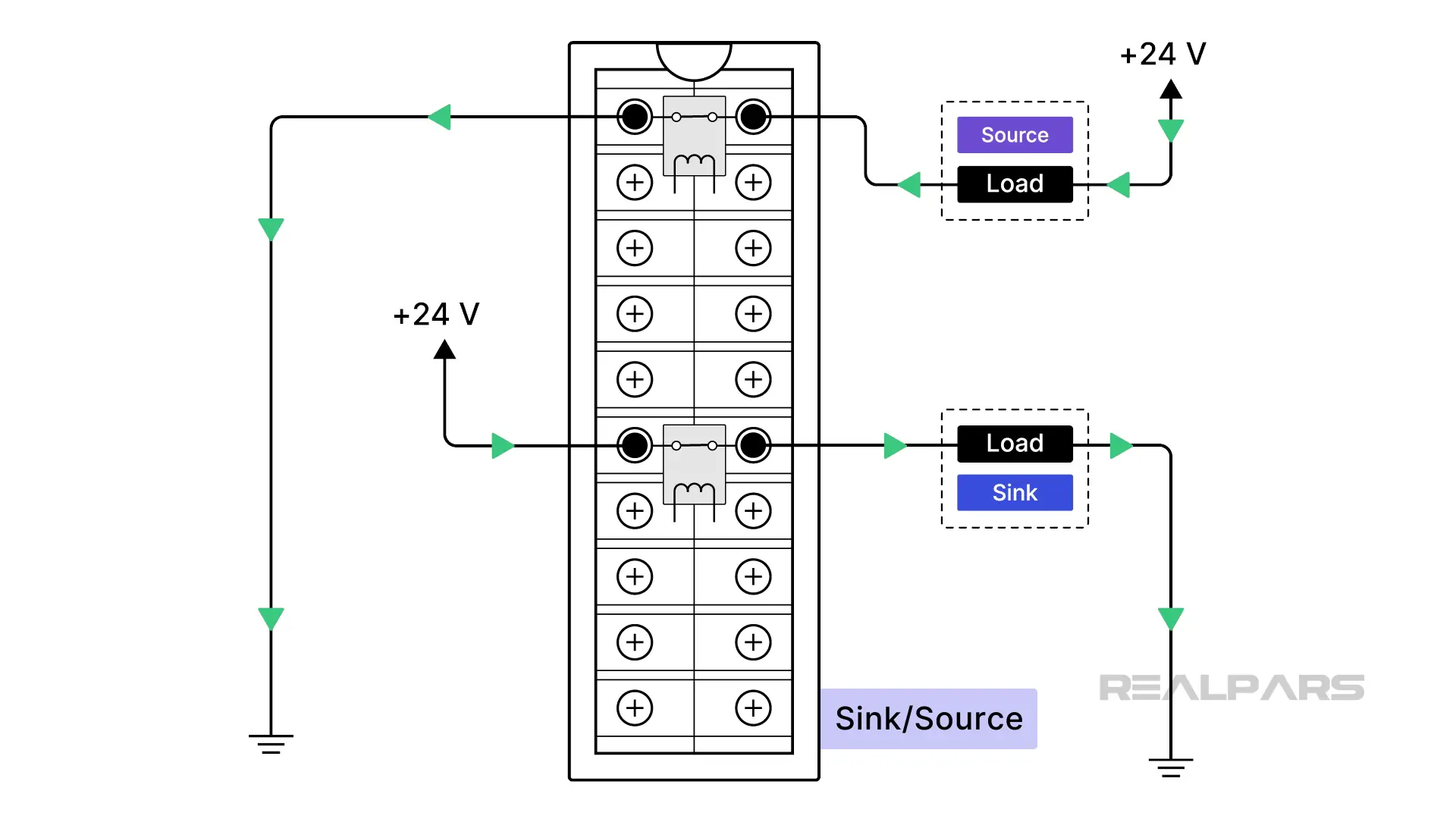
Troubleshooting a dry relay output module is no different from troubleshooting any other relay circuit. So we will focus on troubleshooting solid-state modules.
Modern industrial systems require high switching speeds and, therefore, rely on solid-state output modules that operate more reliably than mechanical relays.
Related Course
Industrial Electrical Maintenance Essentials 1
Output modules
Sinking and sourcing output modules are wired differently. Sourcing modules will connect the load to a supply voltage. Sinking modules will connect the load to a power supply return or ground.
Allen-Bradley 1756-OB16D
We’ll start with the Allen-Bradley 1756-OB16D, which is a 16-output sourcing output module. The letter “D” stands for diagnostic, which places this module in a category superior to many others.
As with many output modules, each output has an ST LED that indicates the output command status. To assist with troubleshooting, this module has FLT LEDs that indicate potential problems with the field devices and associated hardware.
If the ST LED 0 is on, it mirrors the ON command logic as directed by the PLC program. The internal solid-state switch closes, providing approximately +24 volts to the load connected to the output 0 terminal.
- Allen-Bradley 1756-OB16D
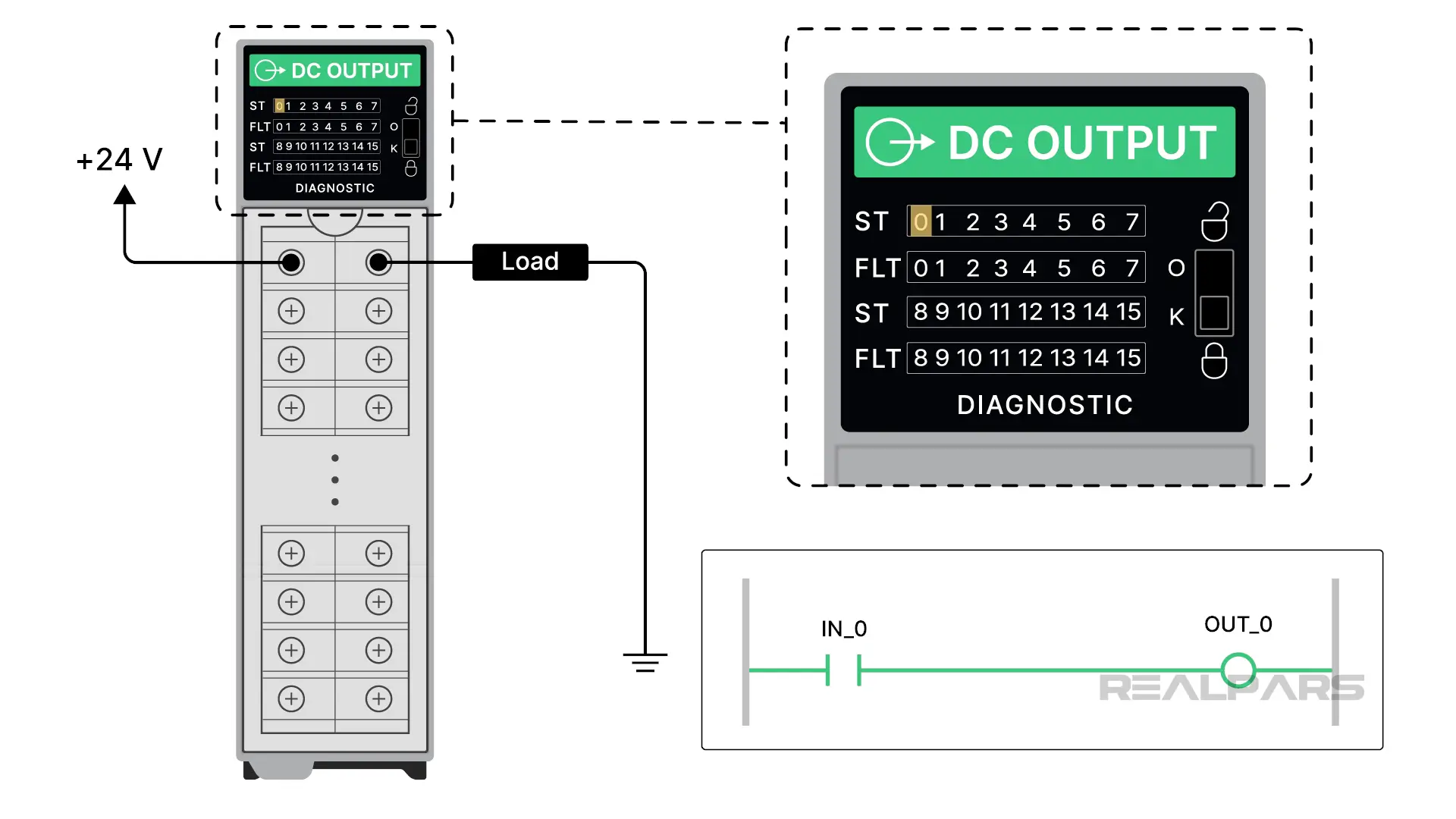
Under normal operating conditions, the solid-state switch drops approximately 1.2 volts across it, thus reducing the load voltage.
The voltage remains present even if the load is open or a wire is broken. That’s where the FLT LEDs can assist with troubleshooting. If the FLT LED 0 is on, it indicates a fault condition on that output, such as an open load or broken wire.
- PLC Output Troubleshooting
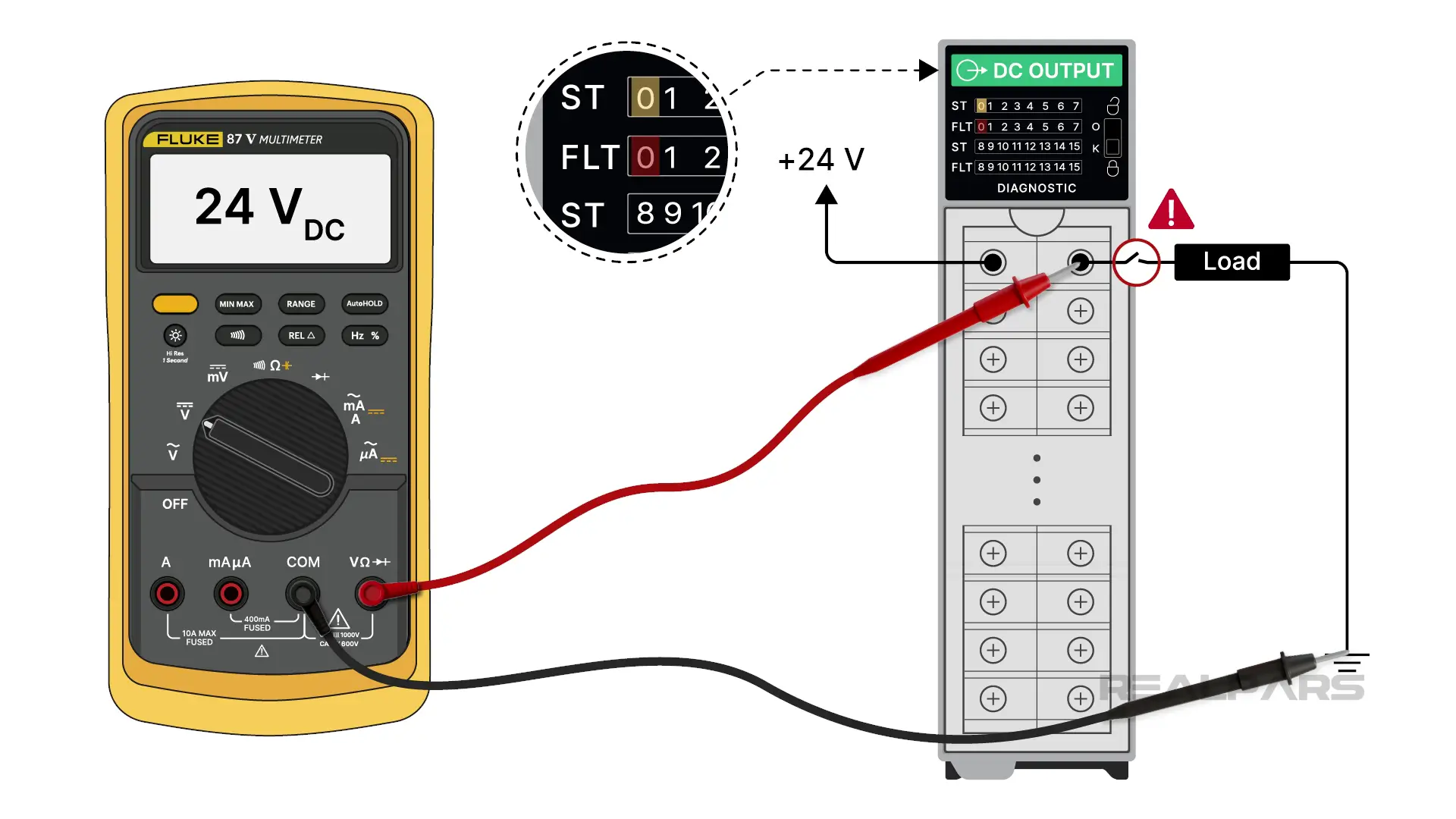
If the ST LED 0 is OFF, the solid-state switch is open, removing the current path to the external circuit. You would expect the output voltage to be zero.
However, because of the internal diagnostic electronics, you may see a significant voltage reading on your high-impedance digital multimeter. Don’t be fooled by this reading.
Many output modules, such as the Allen-Bradley 1769-OB16, have only ST LEDs that indicate the command logic status as directed by the PLC program. Troubleshooting is a bit more challenging and usually requires more voltage measurements.
Allen-Bradley 1756-OV16E
The Allen-Bradley 1756-OV16E is a 16-output sinking module. The letter “E” stands for electronic fusing.
This module requires a +24V supply to power the internal electronics, but it sinks the load current at the module output.
If the ST LED 0 is on, the internal solid-state switch closes, providing a current path through the load to ground. The illuminated LED does not indicate that the output circuit is operating normally; it only shows that the PLC has commanded the internal switch to close.
- Allen-Bradley 1756-OV16E
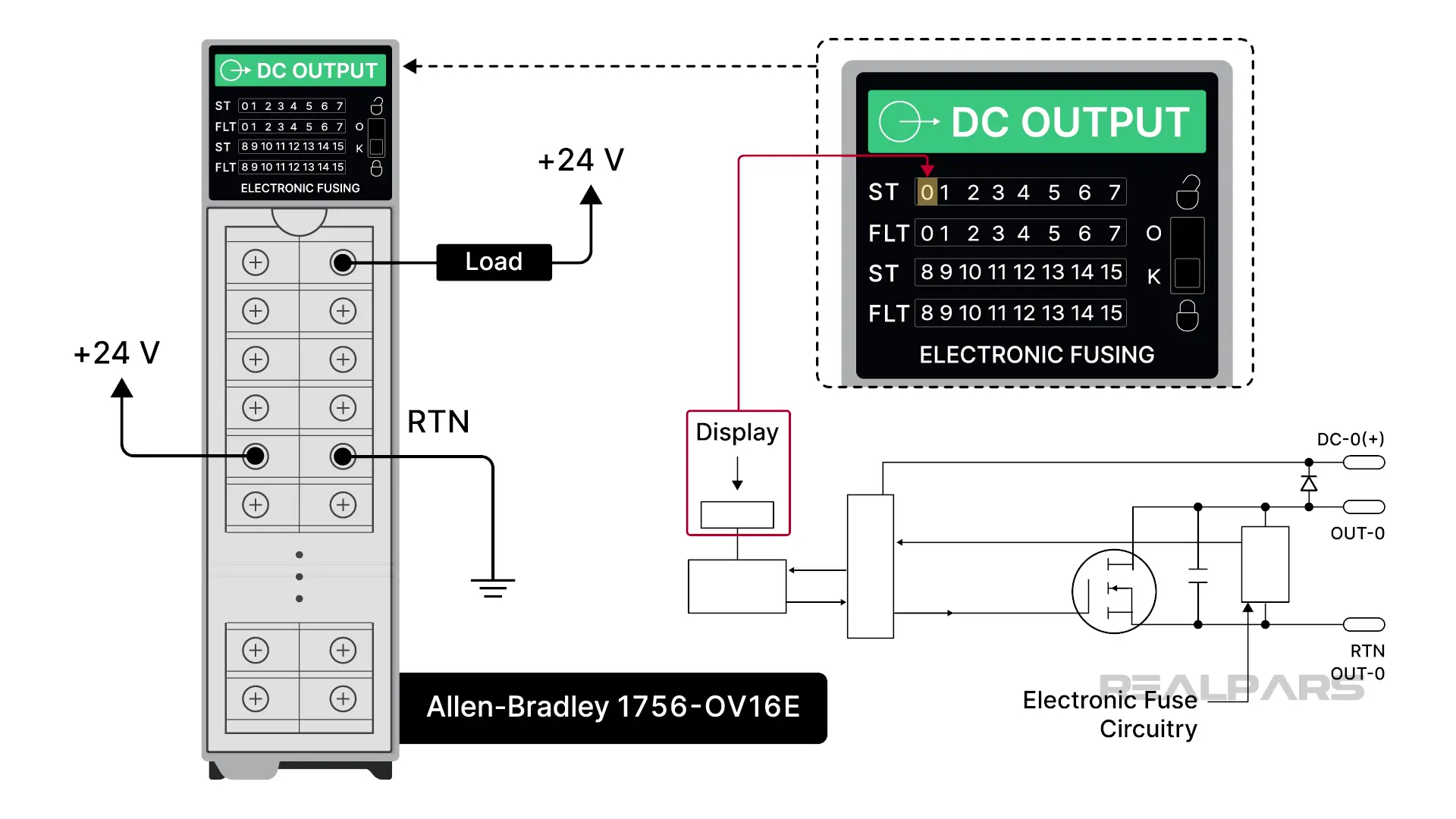
Be cautious when measuring the output voltage. Under normal operating conditions, when LED 0 is off, the output voltage will be 24 volts. If LED 0 is on, the output voltage will be close to zero. The module does not supply the 24 volts, as it originates from the load.
Related Course
PLC Hardware Fundamentals
Learn the basics of PLC hardware in a simple, engaging way.
Wrap-Up
There are a couple of things to keep in mind. Solid-state output module loads are usually externally fused unless the module has built-in electronic fusing, such as the Allen-Bradley 1756-OV16E.
These modules can handle only low-current loads. In general, any load that does not rely on high-speed switching and draws more current than a simple lamp requires an interposing relay.
Understanding sinking and sourcing is crucial for successful PLC troubleshooting. Status LEDs are an excellent resource for troubleshooters, but understanding what they indicate is essential.
Familiarizing yourself with the characteristics of normal and faulted conditions will help you avoid misinterpreting LED conditions and voltage readings.
RealPars for business
Train your team and reduce downtime

