
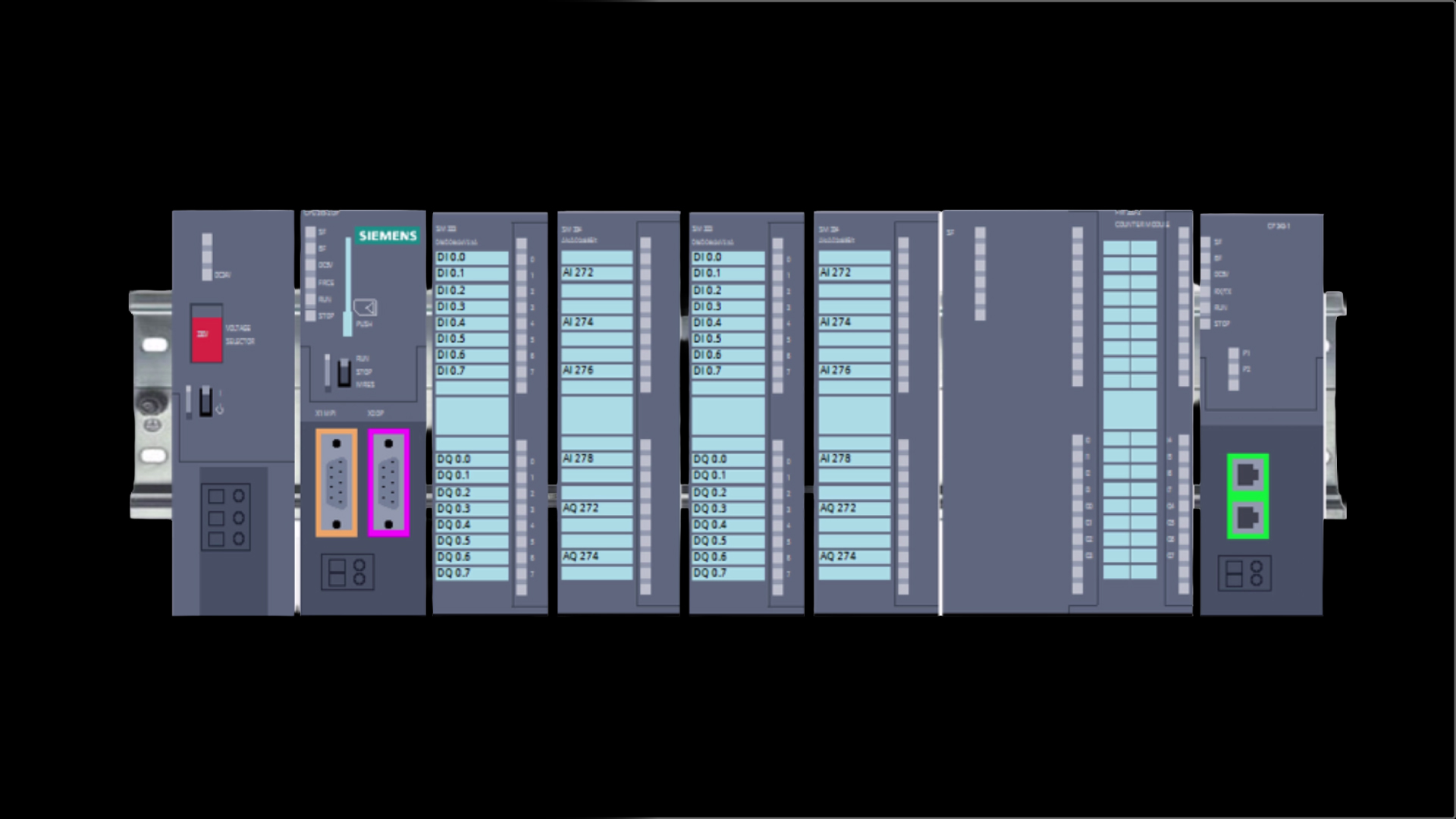
Before a PLC can monitor inputs, process logic, and control outputs, it needs the right hardware foundation. A PLC rack provides that structure by housing the power supply, CPU, and any required input, output, or specialty modules. In this blog, we’ll look at the main parts of a PLC rack, what each module does, and how the final setup depends on the needs of the process.
Watch the video below for a full walkthrough of PLC rack components, or continue reading for a clear written breakdown of each part.
PLC Rack Overview
The first component needed is a rack which holds all of the modules and areas called slots.
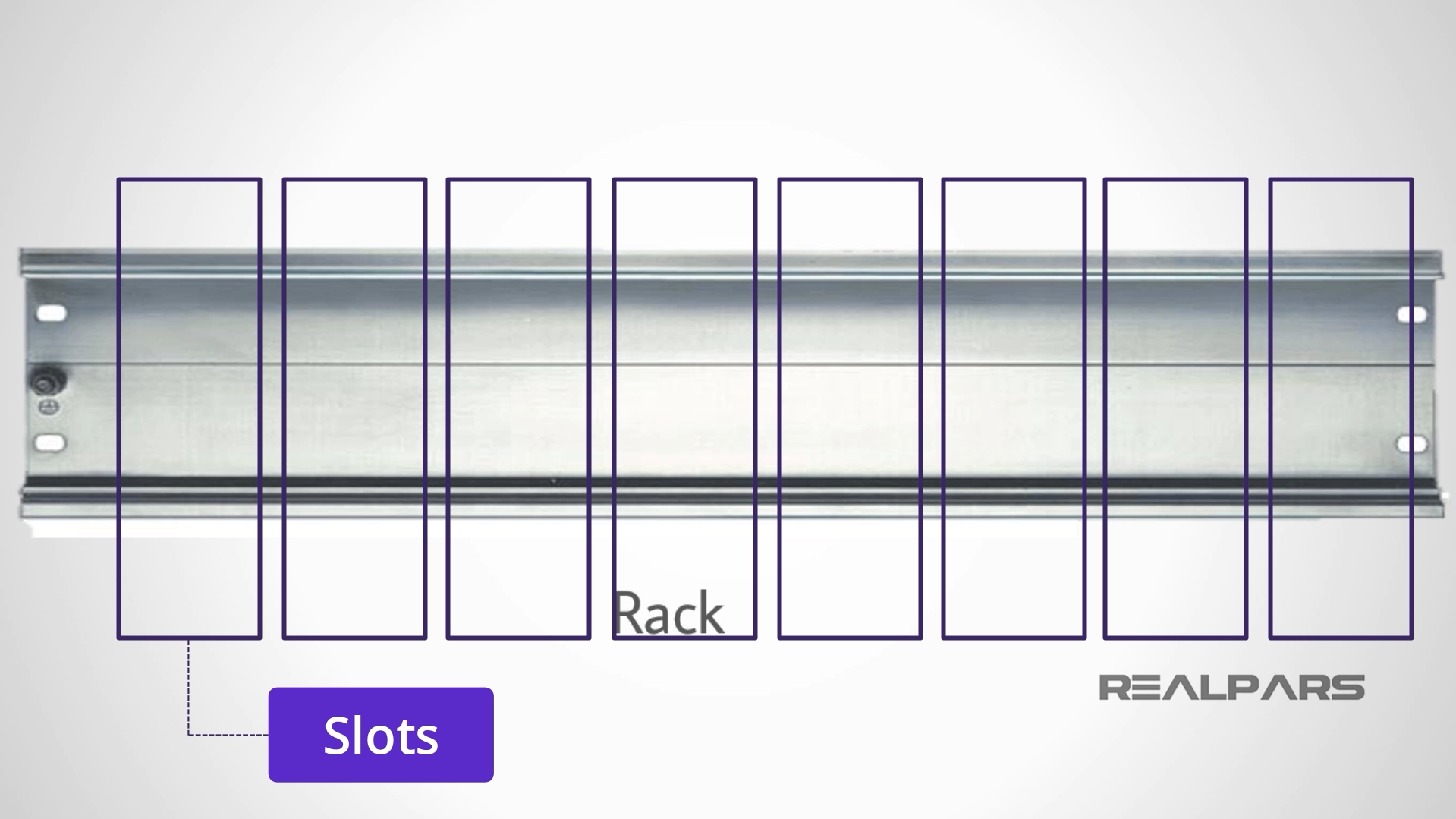
The first slot is typically the power supply module which provides the necessary power to the PLC modules. The output voltage of the power supply that we use is usually 24 volts DC, but the output current varies depending on the number of the modules needed in the PLC.
For instance, this output current could be 2, 5 or 10 ampere. Depending on which and how many modules are used, the output current of the power supply may need to be higher.The second slot usually holds the CPU.
The CPU is the brain of the system, and its job is to evaluate inputs, process the logic in the program we supply and energize the outputs based on that logic.
I/O Modules
After the CPU, we may have any number of different input and output modules depending on the signals and components that we want to monitor and control within the process.
If we have both digital and analog signals in the process, we would install a digital input module here and install an analog input module in the next slot.As for outputs within the system, we can install a digital output module for devices that receive digital signals, like contactors, and an analog output module for items that receive analog signals, such as proportional valves.Depending on which module models are selected, between 8 and 32 separate signals may be connected to these IO modules.
Advanced Modules
Some applications require that particular signals are processed with higher accuracy. Those signals may not be connected to the standard IO modules but instead requires specialized modules called function modules or FM's.FM's process signals independent of the CPU, therefore, providing for higher accuracy.
Another module that may be installed in this rack is a communication processor or CP. The CPU usually contains network ports for use in industrial networks such as MPI, Profibus or Profinet. However, if additional communications ports are needed, we can use a CP module.These are the modules typically used in a PLC.

Module selection depends entirely on the process the PLC will control. Some applications may require the use of the CP or FM modules, while others may not. Other plant processes may need many IO modules and even require expansion racks to accommodate them.
Summary
A PLC rack brings together the key hardware needed for a control system to operate efficiently. From supplying power to processing logic and connecting field devices, each module has a specific role within the overall system. The exact rack configuration depends on the application, the number of signals involved, and any added requirements for communication or high-accuracy processing.
- The rack provides the structure that holds all PLC modules in place.
- The power supply delivers the required DC power for the installed modules.
- The CPU processes inputs, executes the program logic, and controls outputs.
- I/O modules connect the PLC to digital and analog field signals.
- Function and communication modules can be added when the application requires specialized processing or extra network connectivity.

