
If you want a career in industrial automation, you need to know what job titles actually mean. Should you apply to be a controls engineer, commissioning engineer, field service engineer, or a buyer? If you pick the wrong one, you could end up living out of a suitcase when you wanted a desk, or stuck behind a screen when you wanted to work on the factory floor.
In the next few minutes, I’ll break down the major job titles at OEMs to explain what each one does and help you figure out which job is right for you.
A few things to know about OEMs
Before we look at the individual roles, there is one thing worth keeping in mind about original Equipment Manufacturers, or OEMs.
Many OEMs are small businesses with only a handful of employees. That means one person often wears multiple hats, performing the job functions of several roles that would be separate people at a larger company. So as we go through this article, focus on the job functions, not the job titles.
Now let's look at OEM job roles, starting with the Owner.
Owner/executive
Many Original Equipment Manufacturers or OEMs are owned and managed by their original founder. A very common story is that an engineer at an established machine builder decides they can build a better machine, leaves, and starts their own company.
Some of the largest OEMs in the world are still private companies. For example, Tetra Laval Group, the parent of Tetra Pak, has over 14 billion euros in revenue and nearly 34,000 employees, and it's still privately held. That's different from manufacturers or end users, which are much more often publicly traded companies.
This is important because a private company has a very different dynamic from a public one. The owner is often heavily involved in every single decision. At a larger OEM with multiple sites, a local executive usually fills the same role that the owner would at a single-site company.
An owner or executive's performance is typically measured on the profitability of the business, its growth, its security, and cost control. They keep a very close eye on cash flow and the profit and loss statement.
The owner sets the direction, but who turns that direction into machines? That's the engineering department.
Engineering manager
The engineering manager runs the engineering staff and makes the key decisions on technology and vendors. Engineering labor is one of an OEM's biggest costs, so how well the engineering manager controls that cost has a big effect on the company's profitability.
There are two common ways an engineering manager keeps that cost down.
The first is through design standardization, where an Original Equipment Manufacturers or OEM reuses standard designs so that each machine sale needs less custom engineering.
The second is minimizing training needs, for example by choosing technology that's easier to use and by limiting the number of different control platforms the OEM has to support.
The field service team often reports to the engineering manager as well, so the engineering manager also cares about anything that reduces field service cost. A good example is being able to diagnose a machine remotely instead of putting an engineer on a plane.
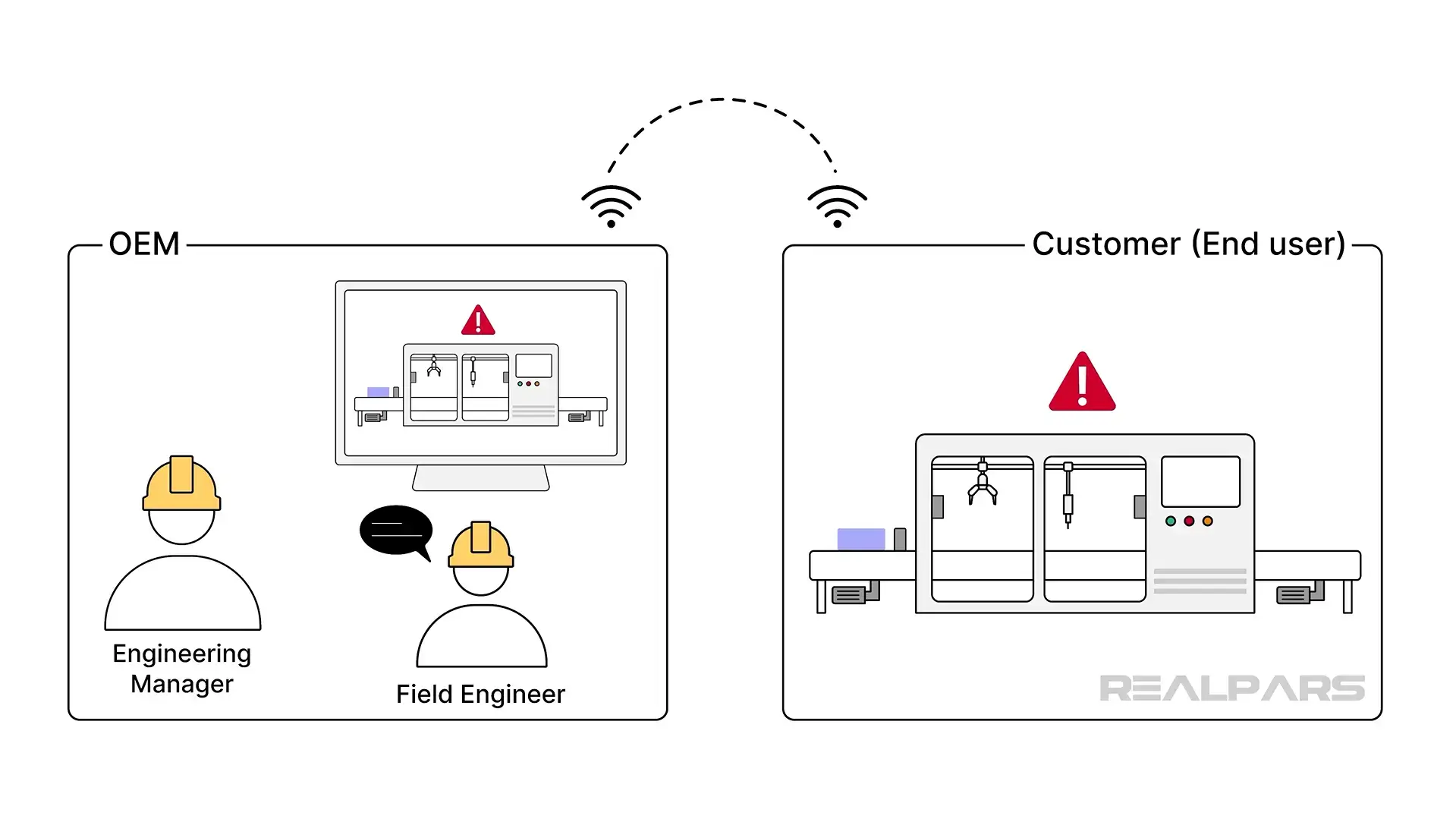
Under the engineering manager are a few key engineering disciplines, so let's look at each one.
Controls engineer
The controls engineer is responsible for all of the controls programming on the machine. They design the control system, program the controllers and the Human Machine Interface, or HMI, set up the automation networks, and configure any other automation devices that need it.
One thing worth knowing is that very few engineering schools actually teach automation. So most controls engineers have learned automation on the job, and the good ones keep learning long after they're hired.
Mechanical engineer
The mechanical engineer designs anything that moves on the machine. In general, they're heavily involved in selecting the motors and drives.
They also confirm that the frame and structure can support the machinery, and they design the movable guards that let people access the machine safely.
Less obviously, the mechanical engineer is often involved in specifying sensors that are used to detect product, confirm operations, and monitor moving parts.
Process engineer
In the process industry, there's often an extra engineering discipline involved in a project called the process engineer. The process engineer is responsible for implementing the process itself. They tend to think in terms of whole systems rather than individual parts, and they often come from a chemical engineering background.
Field service engineer / Commissioning engineer
Once a machine is built, the OEM loads it onto a truck and ships it to the end user. The OEM's field service engineer or technician then travels to the site to get the machine up and running in a process known as commissioning.
When that's done, they represent the OEM during factory acceptance testing, or FAT, where the end user confirms that the equipment meets the agreed performance. Often, that means confirming a machine packages the right number of products per minute, and watching a changeover from one product to another.
The field service engineer may also train the site's operators and maintenance staff on the machine. They handle warranty work and, if the OEM offers it, the longer-term service of the equipment.
These roles involve a lot of travel. Many people, including myself, do a commissioning role early in their career to develop expertise and then leverage that expertise to get a more office-based job.
That covers the engineering and service roles. Now let's look at two roles that make the Original Equipment Manufacturers, or OEM, run as a business: the buyer and sales and marketing.
The buyer (purchasing)
The buyer, in the purchasing department, is responsible for procuring all of the materials and products used to build the machines. A buyer's performance is typically measured on reducing material cost and reducing supply chain cost, for example, by working with fewer suppliers.
Because an OEM's profitability depends so heavily on the cost to build the machine, buyers are hired to be aggressive about cost.
A buyer will often push for commoditization, arguing that competing products from different vendors are functionally equivalent. If they can call the components equivalent, they can choose purely on price, and they'll often drive hard price competition between suppliers. The buyer is influential, and they frequently have the ability to say no.
.webp)
Sales and marketing
The sales and marketing team is responsible for selling and marketing the equipment the OEM produces. A more differentiated, higher-quality machine is easier for them to sell, and it lets the OEM charge a premium price for it.
Keep in mind that small and medium Original Equipment Manufacturers or OEMs often have a very small sales staff, sometimes only a few people for the entire country. So every single machine sale is incredibly valuable to the organization.
Wrap-Up
So now you know the main job roles you'll find at an Original Equipment Manufacturers or OEM, what each one does, and how each one is measured. We covered the owner or executive, the engineering manager, the controls, mechanical, and process engineers, the field service engineer, the buyer, and the sales and marketing team.
And remember, at a small OEM one person may cover several of these roles, so it's the job functions that matter, not the titles.
Understanding these roles helps you see how a machine builder actually operates, and it can help you figure out where you might fit in if you ever decide to work for one.

