
.webp)
Process control is the use of control techniques to regulate process variables and ensure that a process remains stable and consistently produces a good quality product.
In this article, I’ll introduce to the basics of process control. By the end of the article, you will know:
- What a process is and what are the two main types of process
- The difference between open loop and closed loop control
- The components that make up a control loop
- The most common process control strategies used in industry
Processes and process industries
Process is the transformation of raw materials into end products through operations like mixing, heating, cooling, filtering, and storing. These raw materials are typically in liquid, gas, or slurry form.
Process industries include chemical manufacturing, oil and gas, food and beverage, pharmaceutical production, water treatment, and power generation.
This is a different world from discrete manufacturing, where the job is to control distinct on and off events, like a gate that queues boxes on a conveyor or a robot welding parts in sequence. The two ask different things of a controller, and that has a real effect on which PLC you should pick. We go into that in which PLC is better for your process control needs.
Types of processes
There are two main types of process: continuous and batch.
Continuous processes
In a continuous process, material flows constantly and each piece of equipment runs in a single dedicated state. Continuous processes rarely shut down because there is generally a massive cost associated with starting the process and getting it to a steady state.
The goal of a continuous process is to keep the output consistent regardless of how long the process runs.
Cement kilns and oil refining are examples of continuous processes.

Batch processes
In a batch process, the process has defined start and end points and produces discrete quantities of material called batches. Each batch can be traced back to the specific input materials used to produce it.
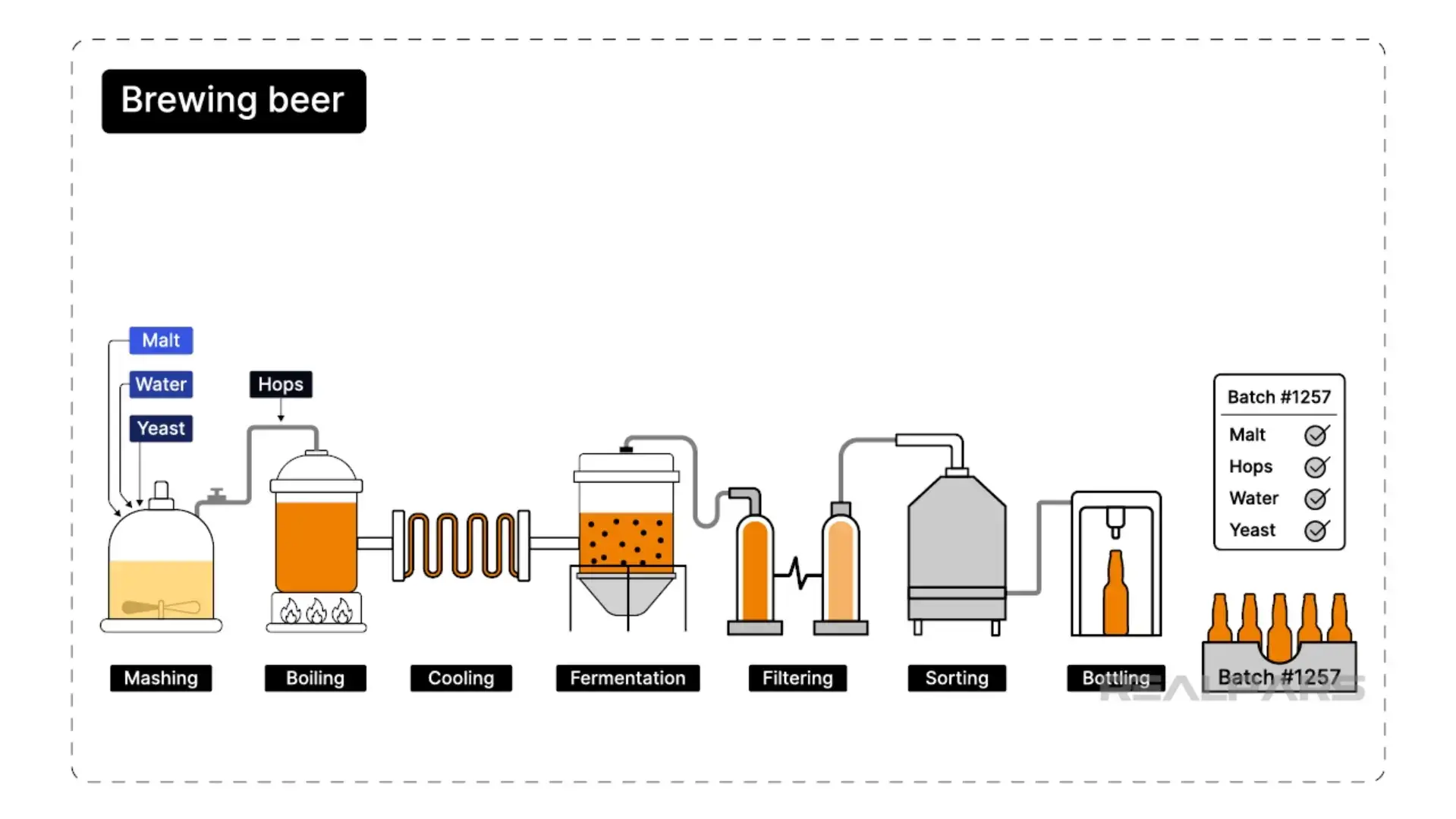
Brewing beer is an example of a batch process. In this process, a specific amount of raw materials are loaded into the process and, after passing through each stage of the process, a batch of beer is produced. This batch of beer can be traced back to the raw materials that were used to produce it if required.
If you'd like to learn more about the differences between continuous and batch processes, check out our article on What's the Difference Between a Continuous and Batch Process.
Open loop and closed loop control
There are two ways to control a process: open loop control and closed loop control.

Open loop control
In open loop control, an action is taken regardless of the current process conditions. A simple example is setting an air conditioning unit to switch on at 10:00 AM and switch off at 7:00 PM every day. The action always happens regardless of the current temperature of the room. Open loop control is simple and inexpensive to implement, but it is often inefficient.
Closed loop control
In closed loop control, the current condition is measured, compared to a target value called a setpoint, and corrected if there is a deviation. Closed loop control is the basis of process automation.
Closed loop control can be manual or automatic.
In manual closed loop control, a person monitors the process variable and adjusts the output manually. They may do this by opening or closing a valve by hand.
In automatic control, a controller makes those adjustments without human intervention.
Related Course
Learn Logix 1
Explore the essence of Logix 5000 and uncover, understand, and master its capabilities.
The control loop
A closed loop control system is made up of three main elements: a measurement device or sensor, a controller, and an actuator.
Sensors
Sensors, also known as primary devices, measure the process variable. Sensors may be equipped with a transmitter. Transmitters convert the raw sensor readings into scaled engineering units that the controller can use. Common sensors used in process control include temperature sensors, pressure sensors, and flow meters.
Controller
The process value is sent to a controller, which compares the process value to the setpoint. Based on the difference between the two, the controller calculates an output to drive the process value back toward the setpoint.
Actuator
The output signal is sent to an actuator, which physically controls the process. Examples of actuators include heaters, pumps, and control valves.
Control strategies
Now that you know how a closed loop control works, let's look at the control strategies used to manage process loops.
PID control
The most common control strategy is a PID loop, or Proportional-Integral-Derivative loop. PID is an algorithm that controls a process using three configurable dimensions: proportional, integral, and derivative. Each dimension is tuned to match the behaviour of the specific process being controlled.
Two-state control
Two-state control is used for simple devices that have only two positions: on or off. A basic on/off valve is a good example. When the process variable falls below a threshold, the valve opens. When it rises above another threshold, the valve closes.

Selective control
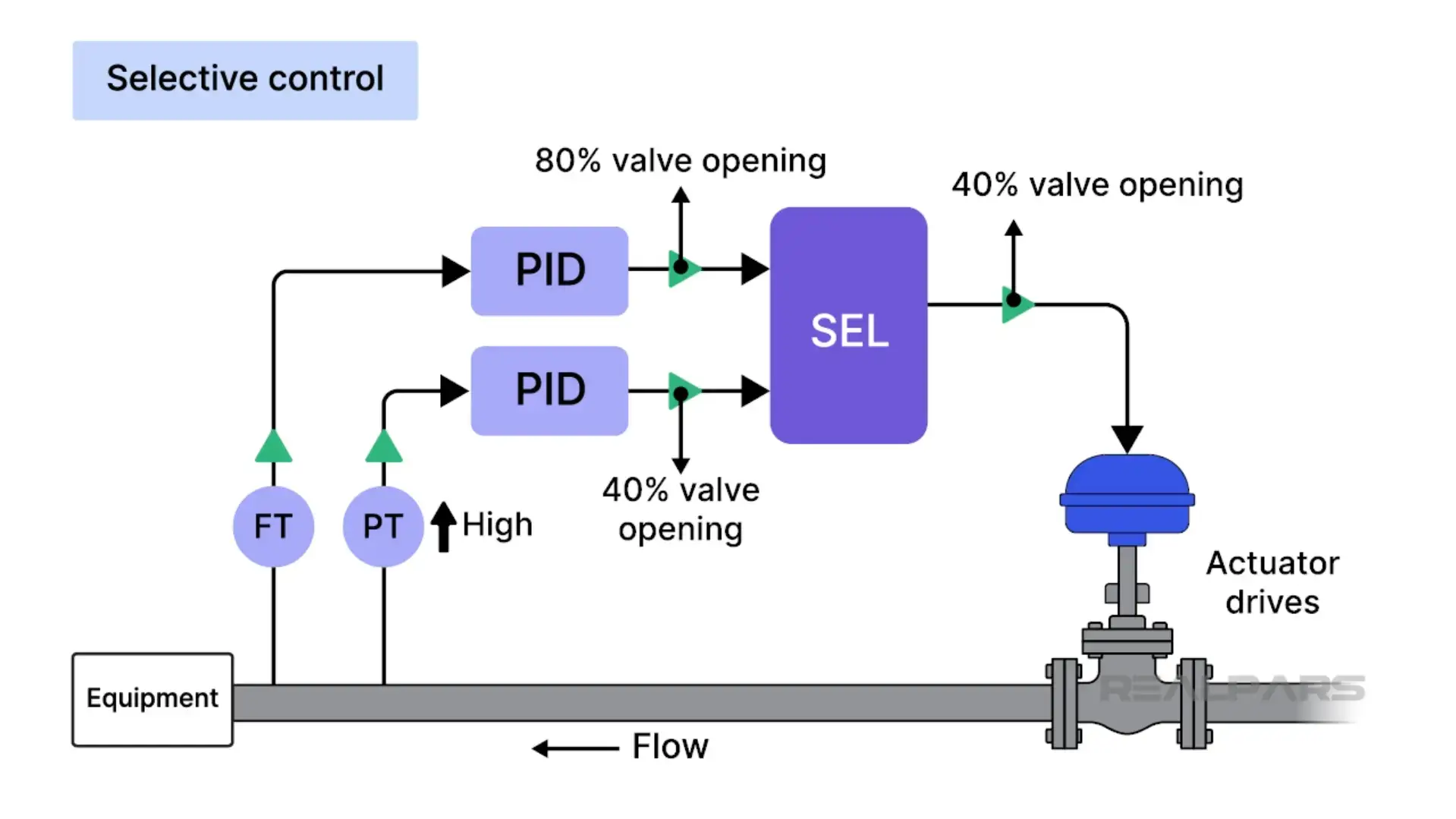
In selective control, two or more control loops feed into a selection instruction, and the output that wins drives the actuator. This strategy is often used to protect equipment so it is often the lowest value that wins.
For example, in a pipe system, one PID loop may be based on a flow meter and another on a pressure sensor. The flow meter loop may demand more flow to meet the setpoint, but if the pressure is rising too high, the pressure PID wins. This protects the equipment even if the flow setpoint is not fully met.
Split range control
In split range control, a single measurement signal drives two actuators that complement each other across the output range. A heat-cool loop is a common example. Depending on the process value, either a heater or a cooler is pulsed to control the setpoint. This approach allows the use of simpler digital devices instead of more expensive analog ones.

Feedforward control
Feedforward control compensates for known disturbances before they have a chance to affect the process variable. This is useful when feedback from a measuring device is slow, as it prevents large swings in the process before the controller has time to react.
Feedforward requires mathematical modelling of the process and can be difficult to implement.

Ratio control
Ratio control maintains a fixed ratio between two input streams. One stream flows in uncontrolled, and the second is calculated and adjusted to stay in proportion with the first.
Acid dilution is a practical example. If a process requires one part acid to be diluted with three parts water, the water may flow freely and the acid flow is continuously calculated and adjusted to maintain that ratio.

Cascade control
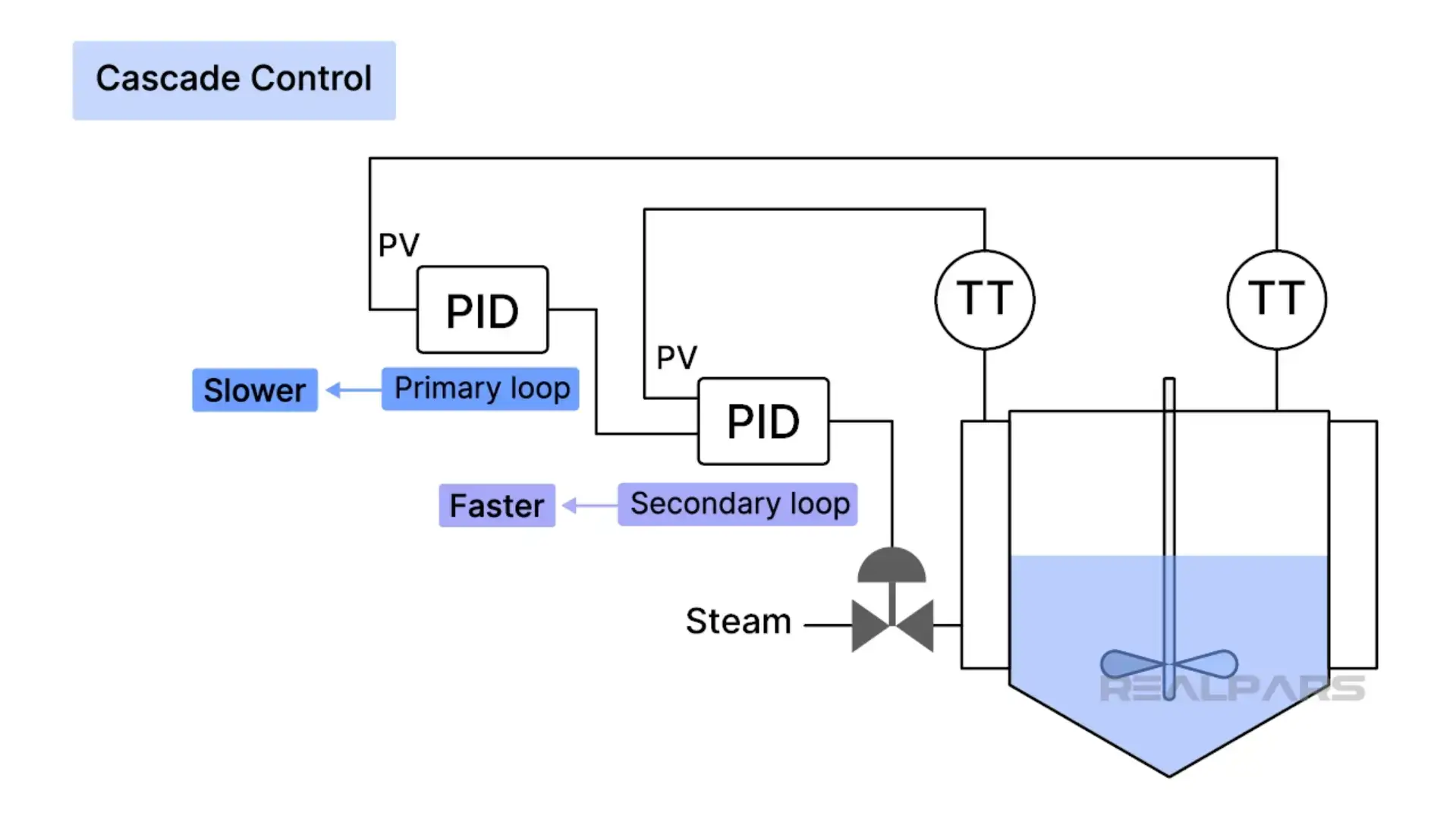
In cascade control, two loops are linked together. The secondary loop reacts faster to disturbances and adjusts the actuator before the slower primary variable is affected.
A common example is a reactor with a temperature jacket. The primary loop controls the product temperature inside the reactor. The secondary loop controls the jacket temperature, adjusting the steam valve in response to jacket temperature changes before those changes have time to affect the product temperature.
Wrap-Up
In this article, I introduced you to the fundamentals of process control. Specifically, you learned:
- What process control is,
- What types of processes exist,
- The difference between open loop and closed loop control
- The structure of a control loop
- Common control strategies used in process control
Train Your Team
RealPars for Business

