
.webp)
In this article, I’ll explain the difference between a continuous and batch process and discuss how these differences affect the way processes are controlled.
By the end of the article, you will know what is meant by process manufacturing, what a batch process is, what a continuous process is, and what the major concerns are when it comes to controlling both batch and continuous processes.
Want a visual explanation? Watch the video below, or continue reading for the detailed breakdown.
What is Process Manufacturing?
Process manufacturing is the changing or refining of raw materials to create new products.
In process manufacturing, raw materials are transported through process equipment as liquids, gases, or slurries. These materials are measured, mixed, heated, cooled, filtered, handled, and stored to produce an end product.
A key feature of process manufacturing is that the end product cannot be distilled back to its basic components - once you mix two liquids, it is impossible to unmix them.
The process that is used to create end products is typically described as a batch or continuous process.
Batch Processes
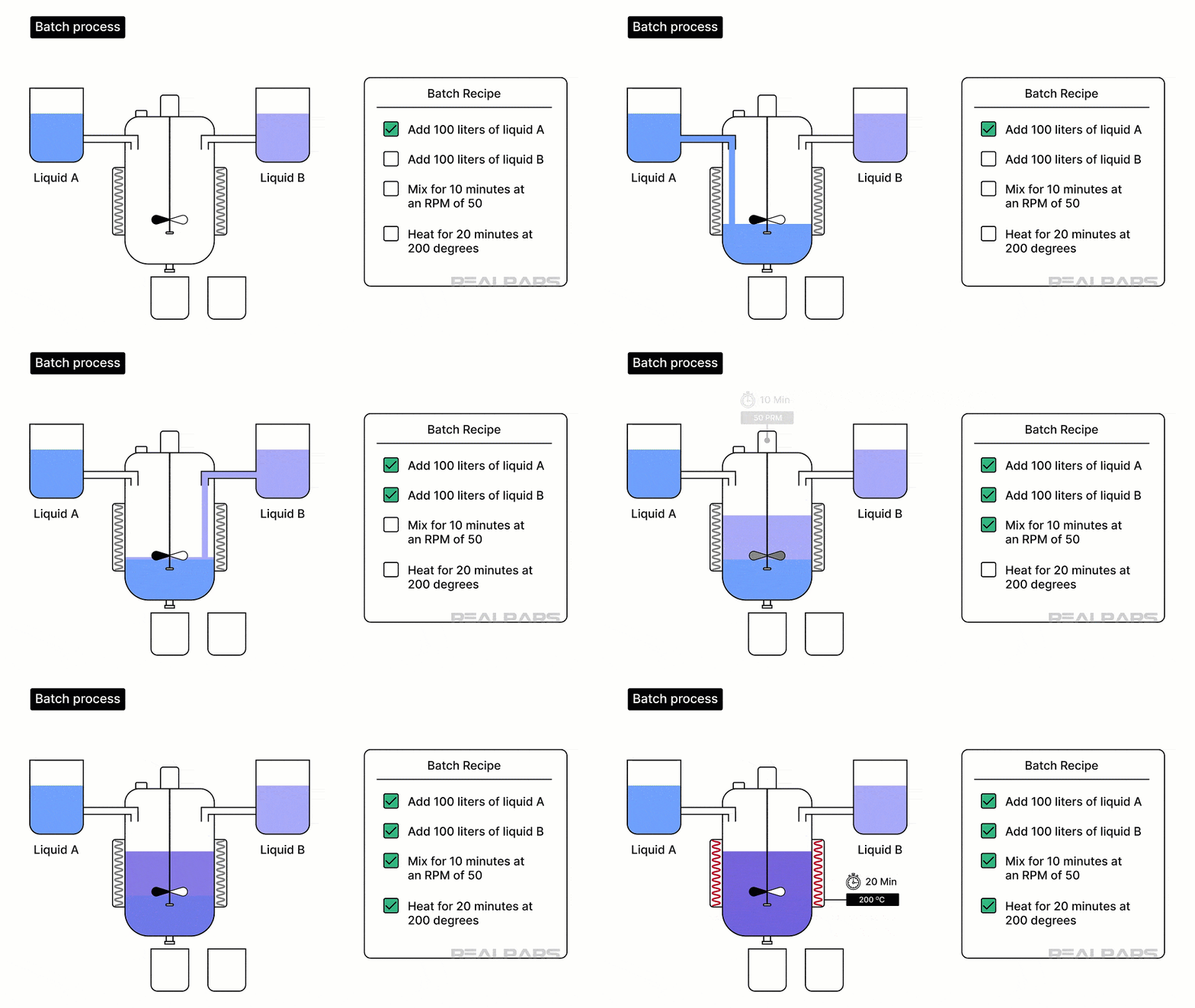
In a batch process, the end product is produced in batches by following a recipe. For example, a recipe might say:
- Add 100 liters of liquid A
- Add 100 liters of liquid B
- Mix for 10 minutes at an RPM of 50
- Heat for 20 minutes at 200 degrees
Since each batch follows the same recipe, each batch has a defined start and end point, and each batch uses a defined quantity of raw materials.
Batch Process Concerns
Some of the main concerns when it comes to controlling batch processes are:
- Consistency,
- Traceability,
- Monitoring,
- Reporting and,
- Safety
Consistency
Each batch has to have the same taste, colour, composition, and, in the case of pharmaceuticals, potency as other batches.
Traceability
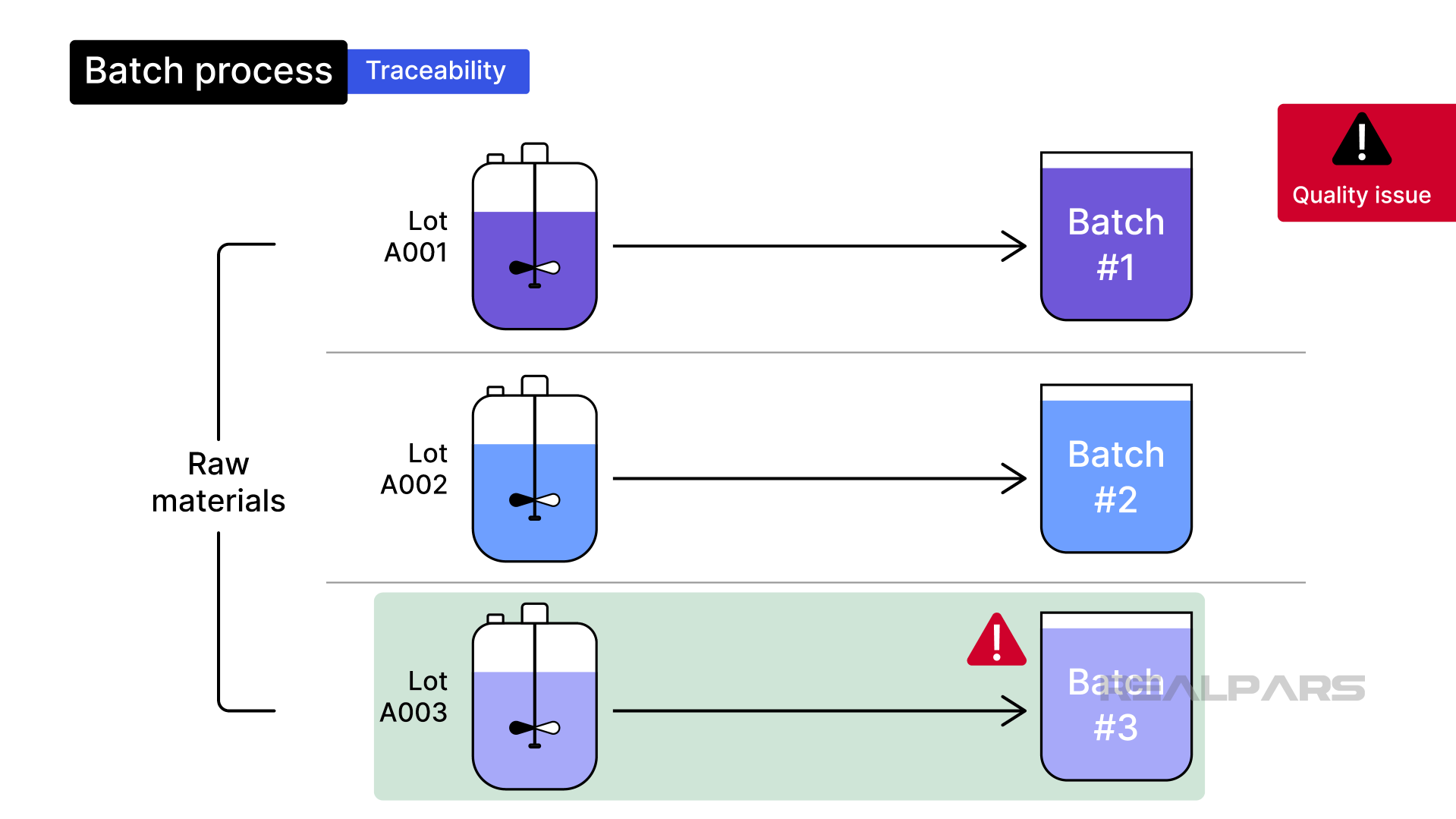
A company should be able to link each batch to the specific lot of raw materials that was used to produce it.
This is important because if a quality issue is discovered, a recall may be necessary. If the company knows which batches are affected, they only have to recall the contaminated batches. If the company doesn’t know which batches were affected, they have to call back all of the batches.
Monitoring
The system controlling the batch process must keep operators informed of the current process conditions and alert them about any deviations. If an operator is alerted about a deviation in the process on time, they may be able to save the current batch. This is important because batch processes are often used to produce valuable products like pharmaceuticals, where losing a batch can have a big economic impact.
Reporting
For production and regulatory purposes, the complete details of each batch must be recorded and stored. Most batch control systems will automatically produce a batch record that details exactly what happened as a batch was produced. For manual, or semi-automatic batch processes, batch records are produced with pen and paper and stored for future reference.
Safety
Finally, safety is a concern in batch processes because many batch processes use dangerous chemicals in confined vessels such as reactors. If the process goes out of control, there is a real-risk of a dangerous situation occurring such as a fire or an explosion.
Now that we understand batch processes, let’s talk about continuous processes.
Continuous Process
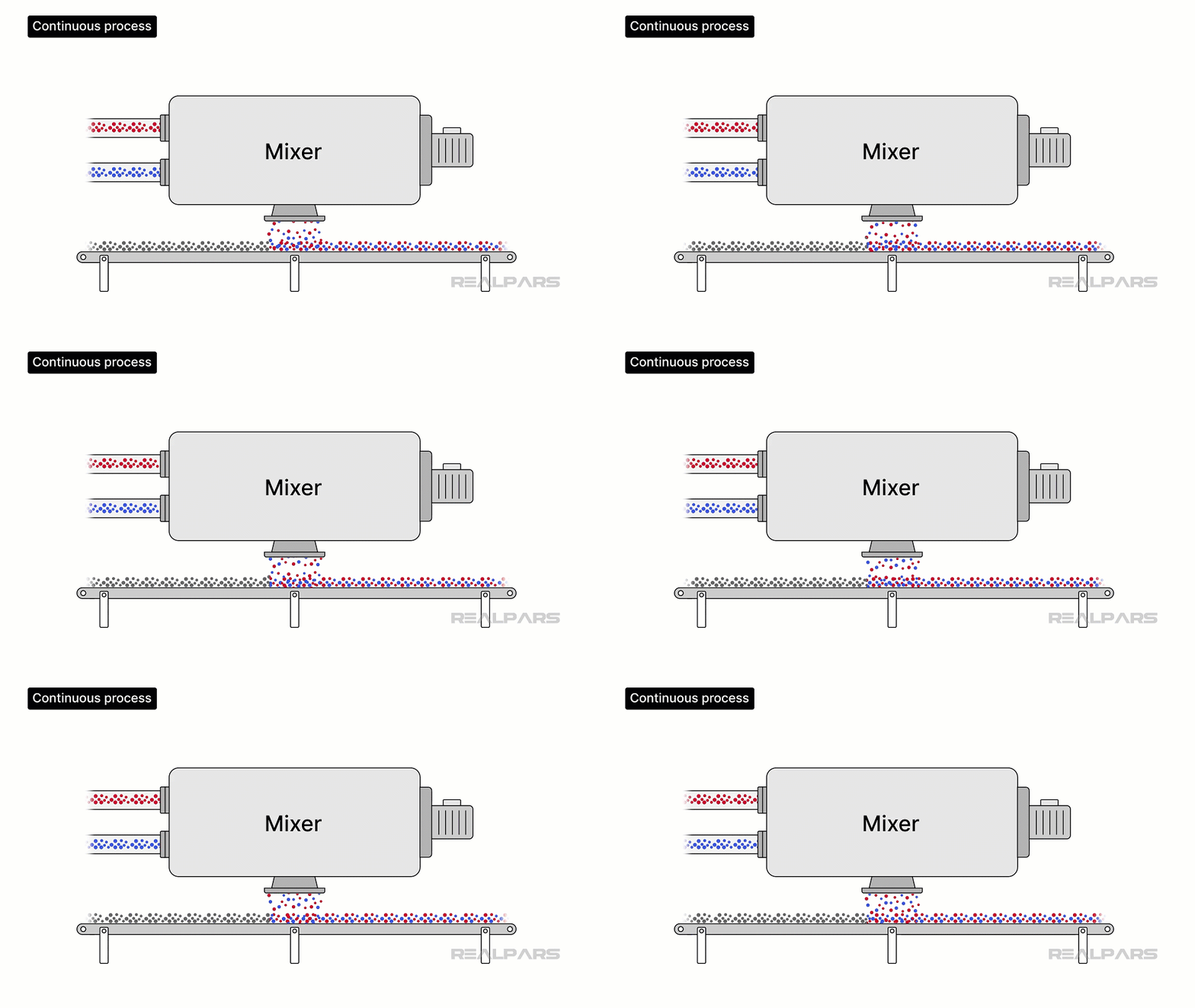
In a continuous process, equipment operates at a constant, steady state and materials continuously flow through the system without a defined start and end point.
For example, in a continuous mixer, materials continuously flow into and out of the mixer. Since there is a continuous flow of materials, there is no way to trace input materials to output materials.
When controlling a continuous process, the goal is to run the process with as few breaks as possible. Systems are designed to avoid unplanned downtime and planned downtime for maintenance, upgrades, and repairs may be more than a year away.
To support equipment and processes that are running continuously, staff work in rotating 24/7 shifts.
Continuous Process Concerns
Some of the main concerns when it comes to controlling continuous processes are:
- Downtime,
- Monitoring and,
- Safety
Downtime
Starting up a continuous process can be challenging and time-consuming so the goal of running a continuous process is to maintain the steady state by limiting startups, shutdowns, and unplanned downtime.
Monitoring
Just like in batch systems, the ability to monitor a process and react in a timely manner to process deviations is important.
Most continuous process produce huge quantities of materials every minute so any deviations in process setpoints can be expensive.
The system controlling a continuous process must be able to adjust to process disturbances
Safety
Just like in batch systems, safety is a concern in continuous processes because many continuous processes use dangerous chemicals. If the process goes out of control, there is a real-risk of a dangerous situation occurring such as a fire or an explosion.
Continuous Vs Batch
Many materials can be produced using a continuous or a batch process. When it comes to deciding if they will use a continuous or a batch process, companies consider several factors including:
- Exceptional Conditions,
- and Variations,
Exceptional Conditions
If an output requires some exceptional conditions such as an extreme temperature in steel manufacturing, then a continuous process will probably be used.
This makes sense because it is very expensive to reach the exceptional condition so once it has been achieved, you want to produce as much material as possible without stopping.
Variations
In contrast, if a factory produces many variations of a product, then they will probably run a batch process.
For example, if a factory wants to use the same equipment to produce different flavors of ice cream, then a batch process makes sense because each flavor can be run as a batch.
Wrap-Up
Now you know what process manufacturing is, the difference between a continuous and batch process, and the main concerns about controlling both continuous and batch processes.
Many of the processes that we have discussed are controlled using PLCs like Allen Bradley CompactLogix and ControlLogix PLCs. If you would like to learn how to control processes using these PLCs, you can check out our Learn Logix series, which is a series of courses that teaches you everything you need to know about programming Logix 5000 PLCs using Studio 5000 Logix Designer.

