
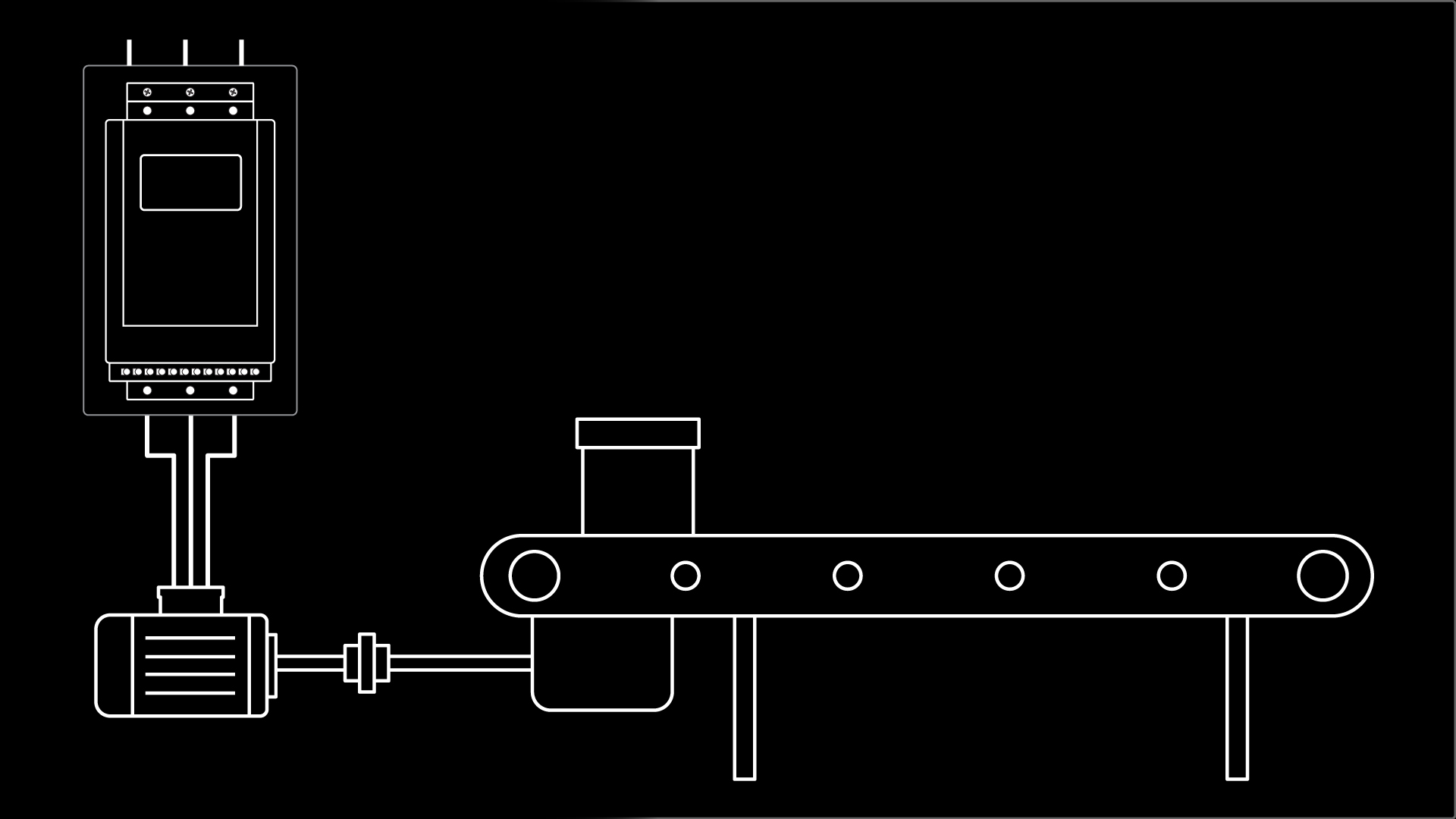
Motor control means starting, stopping, protecting, and regulating the speed of an electric motor. The methods used to control motors range from a simple contactor that only switches the motor on and off, all the way up to a variable frequency drive, or VFD, that controls the motor's speed while it is running.
The motor control method that you need depends on the application that the motor is used in.
For example, if you have a conveyor that's carrying glass bottles in a packing area, you can't wire it to a contactor because the acceleration will be too aggressive and you risk damaging the product.
In this post, I'll explain the different options that are available for motor control and give you guidelines for choosing the right motor control strategy for an application.
What is motor control?
Motor control is how you start, stop, protect, and regulate the speed of an electric motor so it does useful work safely. Those are the four jobs, and the one you actually need decides the method you choose.
A small fan that only ever runs flat out needs almost nothing, a contactor to switch it on and off is enough. A pump that has to ramp up gently and then run at different speeds needs a VFD. Everything in this guide sits between those two, and the rest of the article walks through each option and when to use it.
The most common, and simplest, way to control a motor is to use a contactor and overload relay. This combination is known as an across-the-line starter, direct-online-starter, or DOL starter.
A contactor is really just a heavy-duty relay. The difference is that a contactor is built to switch the motor's load current, with bigger contacts and a place to add an overload relay, while a plain relay only switches small control signals.
Control voltage is used to energize the contactor’s coil, which causes the contacts to close, supplying full line voltage to the motor.
When the control voltage is dropped, or the overload relay is tripped, the motor coasts to a stop.
A DOL starter is a simple and cheap way to start, stop, and protect a motor. However, there are two disadvantages to using a DOL starter. Specifically, when the full line voltage is applied to the motor, the motor pulls a large inrush current, which is typically six to eight times its full load current. This can be problematic as it can affect other electrical devices.
A DOL starter also accelerates a load aggressively, which can damage mechanical parts and may be a problem for specific applications like conveyors transporting bottles.
To learn more about basic starters, check out our article Motor Starter Explained . And to learn how to wire a 3-phase motor in a simple, easy-to-follow way, check out our 3-phase motor wiring Diagram guide.
Reduced-voltage and soft starters
For applications that require a gentle acceleration of the load, reduced-voltage starting is used. With reduced-voltage starting, the voltage provided to the motor is ramped up over time to produce a controlled acceleration of the load. There are two options that are commonly used for reduced-voltage starting. They are star-delta starters and soft starters.
The classic electromechanical reduced-voltage starter is the star-delta starter, also called wye-delta. It starts the motor with its windings in a star connection, which drops the starting current and torque to roughly one-third of what a direct-on-line start would draw, then switches to delta for full-speed running. This motor control technique is cheap, and it has no electronics, but it starts in two abrupt steps rather than a smooth ramp, and it only works on motors wired to allow it.
To learn more about star-delta starters, check out our blog post Star Delta Starter PLC Program and Wiring.
Another reduced-voltage starting option is the soft starter. A soft starter uses solid-state devices to gradually raise the voltage to the motor over a set ramp time, so current and torque climb smoothly instead of slamming on. The soft starter also provides deceleration, which may be required in certain applications.
To learn more about soft starters, check out our article What Is a Soft Starter?
On the bottle conveyor that we talked about before, a reduced-voltage starting method would control the acceleration and deceleration of the conveyor, but it wouldn't let you control the speed of the conveyor. In the next section, we'll look at a motor control technology that lets you finely control speed.
VFDs: controlling speed, not just starting
If a motor control application needs speed to be finely controlled or changed, you need a variable frequency drive or VFD.
Under the hood, a VFD rectifies the incoming AC to DC, holds it on a DC bus, then inverts it back to AC at whatever frequency it chooses. Since the speed of the motor is defined by the frequency of the voltage supplied to it, VFDs can control a motor's speed. Unlike a soft starter, which controls the acceleration and deceleration of a motor, a VFD controls the acceleration, deceleration, and running speed of a motor.
VFDs are very useful for applications that require a motor to run at multiple speeds. A good example of this is a cooling fan, which needs to run quickly on hot afternoons and can run slowly on cooler ones. If you use a contactor to control the fan, it will always run at the highest speed, but if you use a VFD, you can control the speed of the fan based on the temperature. By running the fan at a slower speed, companies can reduce their energy bills and the wear on mechanical parts.
Soft starter vs VFD: which one do you need?
Here is a quick reference comparison between the different motor control methods.
Contactor or DOL: use it when the motor is small enough that inrush current does not matter, and it only ever runs at full speed. This is the default control method, and most motors in a factory use it.
Star-delta: use it on a larger fixed-speed motor where you need to cut the starting current but do not need speed control and want to avoid the cost of electronics. Star-delta starters are increasingly being replaced by soft starters, but there are still plenty out there.
Soft starter: use it when the load needs a gentle start or stop but runs at one fixed speed once it is going.
VFD: use it when the load runs at different speeds or the application full torque at low speed.
The building blocks of a motor control circuit
Now that we know what motor control technologies exist, let's see how they are placed in a control panel to build a motor control circuit.
Pushbuttons and pilot devices
On the outside of a control panel, you will see push buttons, selector switches, and pilot lights.
These are devices that let someone interact with the motor control circuit, typically by manually controlling motors for maintenance and testing.
Contactor
For simple motor control, contactors are used to switch power to a motor. As we have already discussed, when the coil of the contactor is energized, line power is fed to the motor, and when the coil is de-energized, the contacts open and the motor stops.
Overload relay
Overload relays are used to protect motors. They monitor the current going to the motor and, if the motor draws too much current for too long, the overload trips and cuts line power from the motor. Typically, a high current draw from a motor indicates that the motor is jammed or overloaded.
How you size an overload matters. In North America, motor overload and short-circuit protection follows NEC Article 430, so the overload is sized to the motor's full load current per that code. It is also worth knowing that overloads and their contactors are rated to one of two standards, NEMA or IEC. NEMA ratings are more conservative and common in North America, while IEC ratings are more compact and common in Europe, so when you spec a starter you need to know which one you are working with.
Soft starters and Variable Frequency Drives
A panel may contain a combination of contactors, soft starters, and variable frequency drives for controlling different motors with different application requirements.
During my time working as a controls engineer with a large material handling systems integrator, we typically used a combination of DOL motor control for conveyors that did not need acceleration control, soft starters for conveyors that needed to accelerate and decelerate slowly, and VFDs for conveyors that required precise speed control like sorters. Often, these devices were all combined in a single panel.
Control transformer/Power supply
Line voltage is often 480 volts AC, while most control devices run on 24 volts DC. A control power supply, or control transformer, is used to convert the incoming power to 24 volts DC to run the control equipment like PLCs and contactor coils.
Power circuit versus control circuit
As you can see, there are two electrical circuits in a control panel.
The power circuit provides power to devices like motors.
The control circuit provides power to control devices like contactor coils.
Motor control centers (MCCs)
So far, we have talked about individual and small groups of motors.
In a real plant or factory, there can be hundreds of motors and wiring every motor control device in its own control panel doesn't scale.
To address this issue, companies use motor control centers, or MCCs, to organize their motor controllers. An MCC is a standardized line up of vertical sections, split into individual compartments called buckets. Each compartment contains one piece of equipment such as a motor starter, soft starter, or drive and all of the buckets are fed from a common bus.
A motor control center is not another motor control technology. Instead, it is a way to organize, wire, power, and maintain the motor control technologies that we have already talked about.
You will typically find MCCs wherever motor counts are high. That is typically manufacturing plants, water and wastewater treatment, mining, and large commercial facilities.
How to choose the right motor control method
To help you choose which motor control method you need for an application, you can run through this list of questions:
Do you only need on and off, on a small motor that always runs full speed? A contactor, as a DOL starter with an overload, is all you need. This is low cost, often around $50 to $150 in parts for a small motor, and easy to maintain and operate.
Is inrush or a harsh start a problem, but the speed stays fixed? A soft starter, or a star-delta starter on a budget. This is a more expensive option, roughly $300 to $1,000 for a soft starter, or about $200 to $600 for a star-delta setup, and may require some configuration, but will give you a smooth acceleration and less mechanical wear.
Do you need variable speed or full torque at low speed? Then use a VFD. It is the highest purchase cost, starting around $300 to $500 for a small drive and $1,000 or more for mid-size units, and the most complex to set up, but nothing else gives you continuous speed control.
Do you need precise position, not just speed? Then you may need servo control, which is outside the scope of this post. Our servo motor guide covers this topic, and our stepper motor guide covers the lower-cost positioning option.
By Ken Bourke. Controls engineer with +10 years building motor control panels for material handling systems.

