
.jpg)
Prefer watching instead? Check out the video below, or keep reading for the full step-by-step explanation.
Let’s say that you have a floor lamp in your living room. To turn this floor lamp on, you plug it into the wall, flip the switch, and the lamp turns on.
Now, what you take in your hand and plug into the wall outlet is cable. Inside this cable, there are two wires. One of these wires is what we call a hot wire, and the other one is what we call a neutral wire.
When you plug the cable into the outlet, the electricity flows through the hot wire and travels all the way to the switch. It stays there as long as the switch is open, but as soon as you press the switch, the electricity starts to flow to the lamp.
At the bottom of the lamp, there is one input and one output. The electricity goes into the lamp via the input and then comes out of the lamp via the output.
The output of the lamp is connected to the neutral wire. So the electricity uses this neutral wire to go back to the outlet. And when this happens, we have a complete circuit and the lamp turns on.
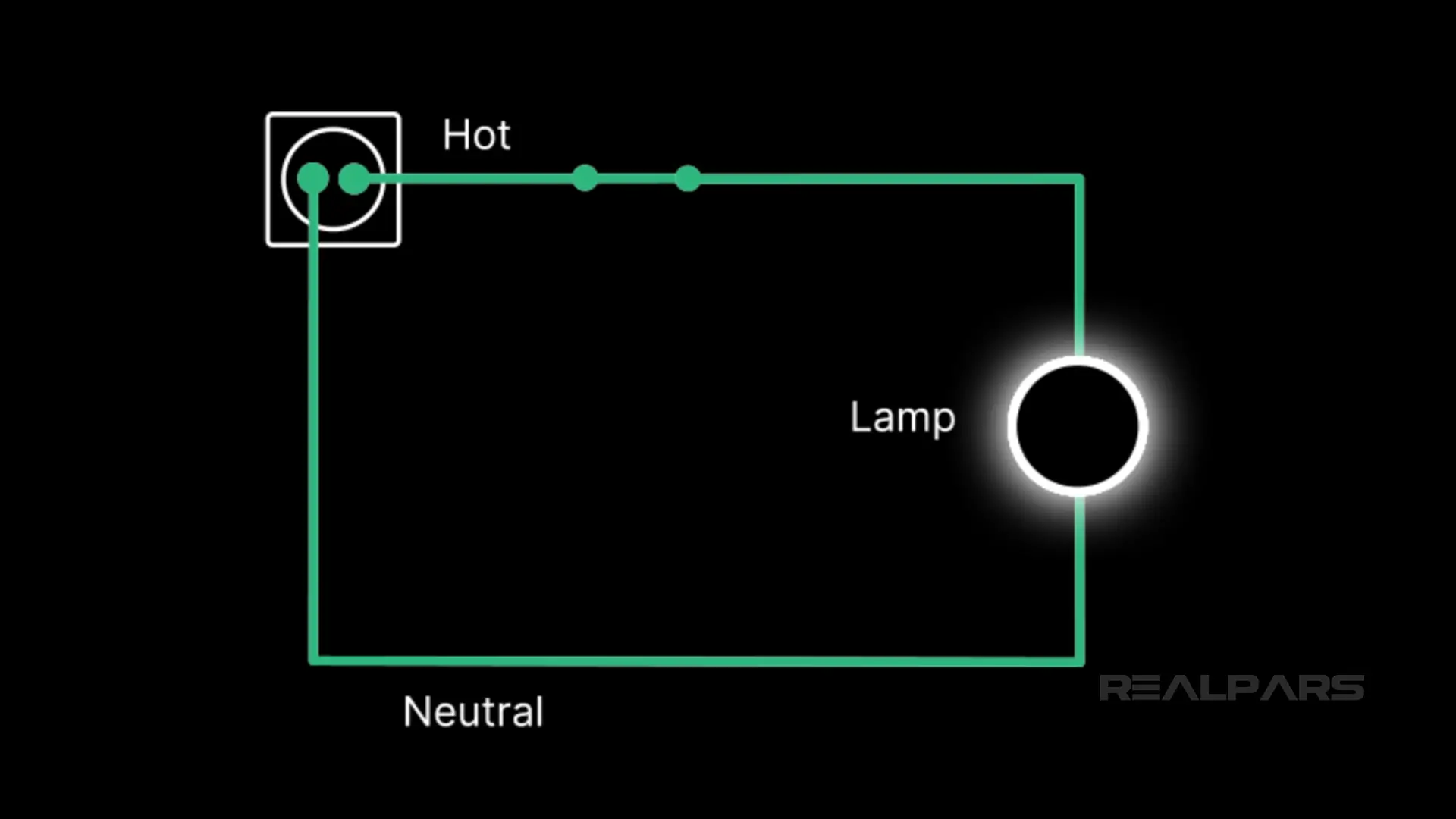
So the electricity goes from the outlet to the hot wire and then to the switch and then to the lamp and then comes back to the outlet through the neutral wire.
Now, this lamp here slows the electricity down. This slowdown is what we call resistance. Now, this slows down, or resistance is very important because it controls how much current can flow within the circuit.
For example, in a circuit like this, the normal current rate can be about 1 amp. So as long as we have this lamp within the circuit, we can slow the flow of electricity, and by doing this, we can keep it in control and in about the 1-amp range.
What is a short circuit?
But now let’s remove this lamp. What happens when I do this? Well, if I remove the lamp, there won’t be anything else within the circuit that can slow down the electricity and keep it in control.
That means when I remove the lamp, I remove the resistance, which means zero resistance, and when resistance goes to zero, current goes extremely high in a very short period of time, like going from 1 amp to 1,000 amps, and this is what we call a short circuit.
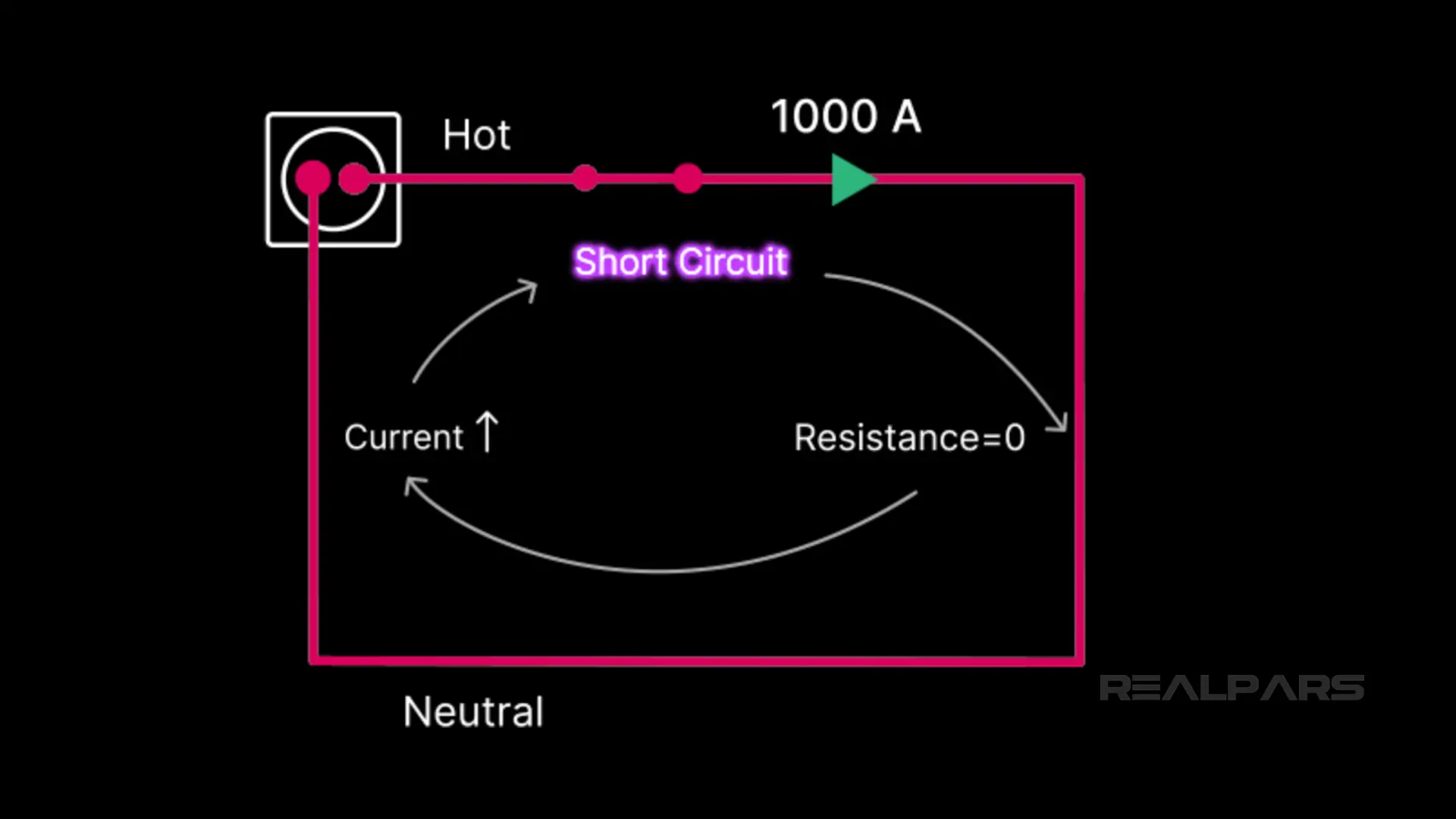
So a short circuit happens when the source of control in a circuit is gone, and when that happens, there is nothing else within the circuit that can control the current; the resistance goes to zero, and the current goes very, very high, like going from 1 amp to 1,000 amps, and that is basically what we call a short circuit. Very simple, right?
Why are short circuits dangerous?
Now, what happens when a short circuit occurs? Well, when a short circuit happens, as I mentioned, the current goes extremely high. When the current goes extremely high, the temperature will also go extremely high, and when that happens, a lot of other bad things can happen.
For example, the high temperature can melt the wires or can even start a fire. In big industrial systems, a short circuit can cause a big explosion or damage to personnel as well.
Now, if you zoom out from the electrical engineering world and look at other things in the world around us, you can realize that a short circuit just follows the rules of physics, and that is when you remove the main source of control in anything fast, there is always a spark of things going out of control extremely fast.
For example, in a big city, the traffic lights control the flow of cars, right? Now, if all of a sudden, all of these traffic lights stop working, things can get out of control, and hundreds of cars around the city can crash into each other in a short period of time.
Or to give you another example, if in a big city, all of a sudden, you remove the police and the government, which are the source of control in a city, in a short period of time, you’ll see a very extreme spike of bad people doing bad things. Why? Because there is nothing that can control these bad people anymore, and they can do whatever they want.
Now, going back to the electrical engineering world, you see that a short circuit is nothing more than removing the source of control for the electricity.
For example, in our simple but practical circuit, the lamp is the source of control, and as soon as I removed that, there was no control, resistance went to zero, current went very high, and following that, the temperature went very high as well.
So electricity is good. But it is good as long as we can keep it under control, and as soon as it gets out of control, bad things can happen.
How to stop a short circuit
Now, as I mentioned, short circuits are dangerous, but the question is, is there anything that can keep the circuit safe when a short circuit happens? Is there any way we can protect a circuit against a short circuit?
The answer is yes. For that purpose, we can use a fuse. A fuse is just a simple electrical component like this one you can see here.
Inside the fuse, there is a very thin metal wire. If too much electricity passes through this thin wire, the temperature goes high, and the wire burns.
Now let’s go back to our circuit again and add a fuse here right before the switch.
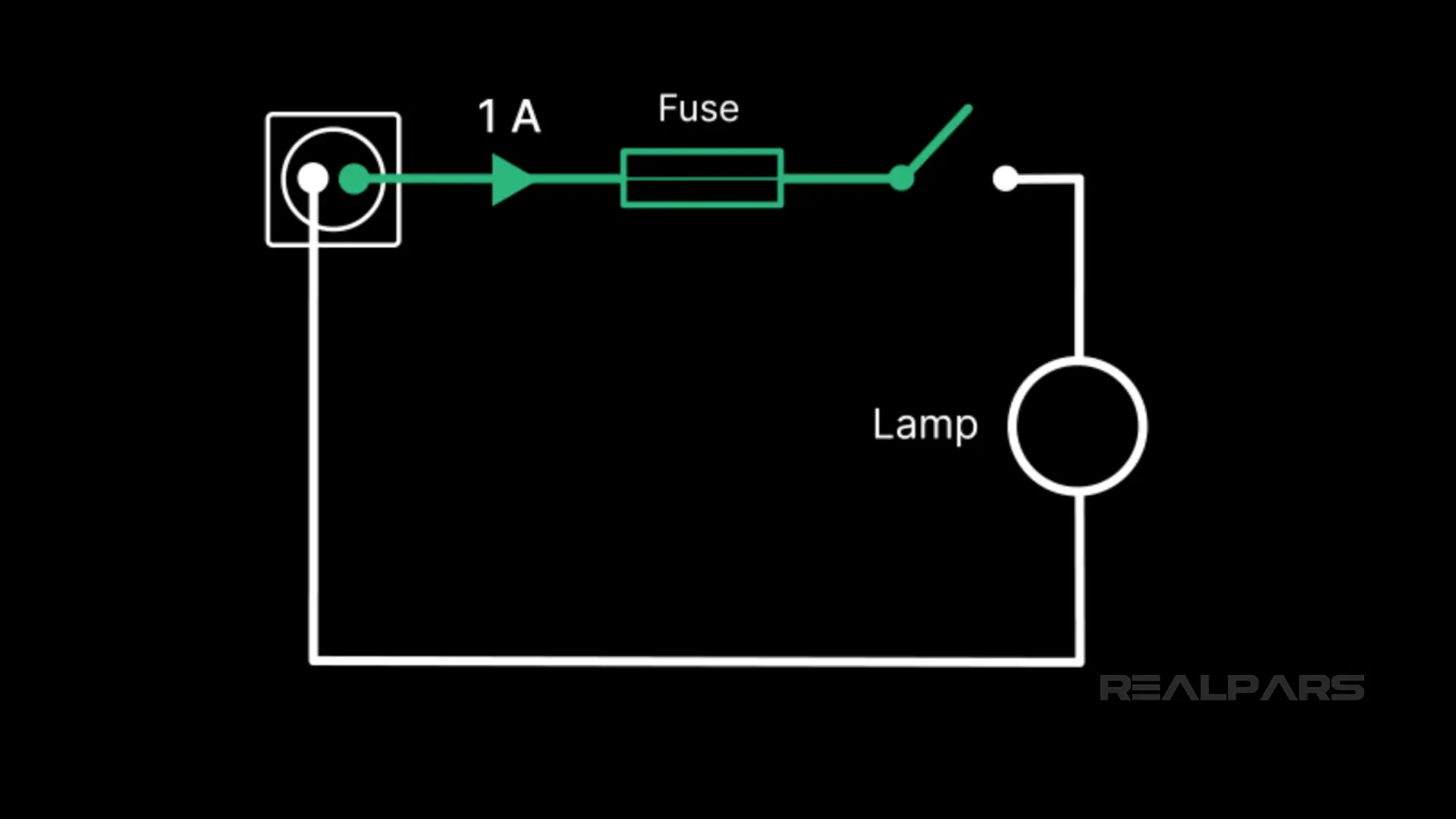
Now, when the lamp is in the circuit, if I press the switch, the electricity flows to the lamp from one side, comes out of the lamp from the other side, and goes back to the outlet through the neutral wire.
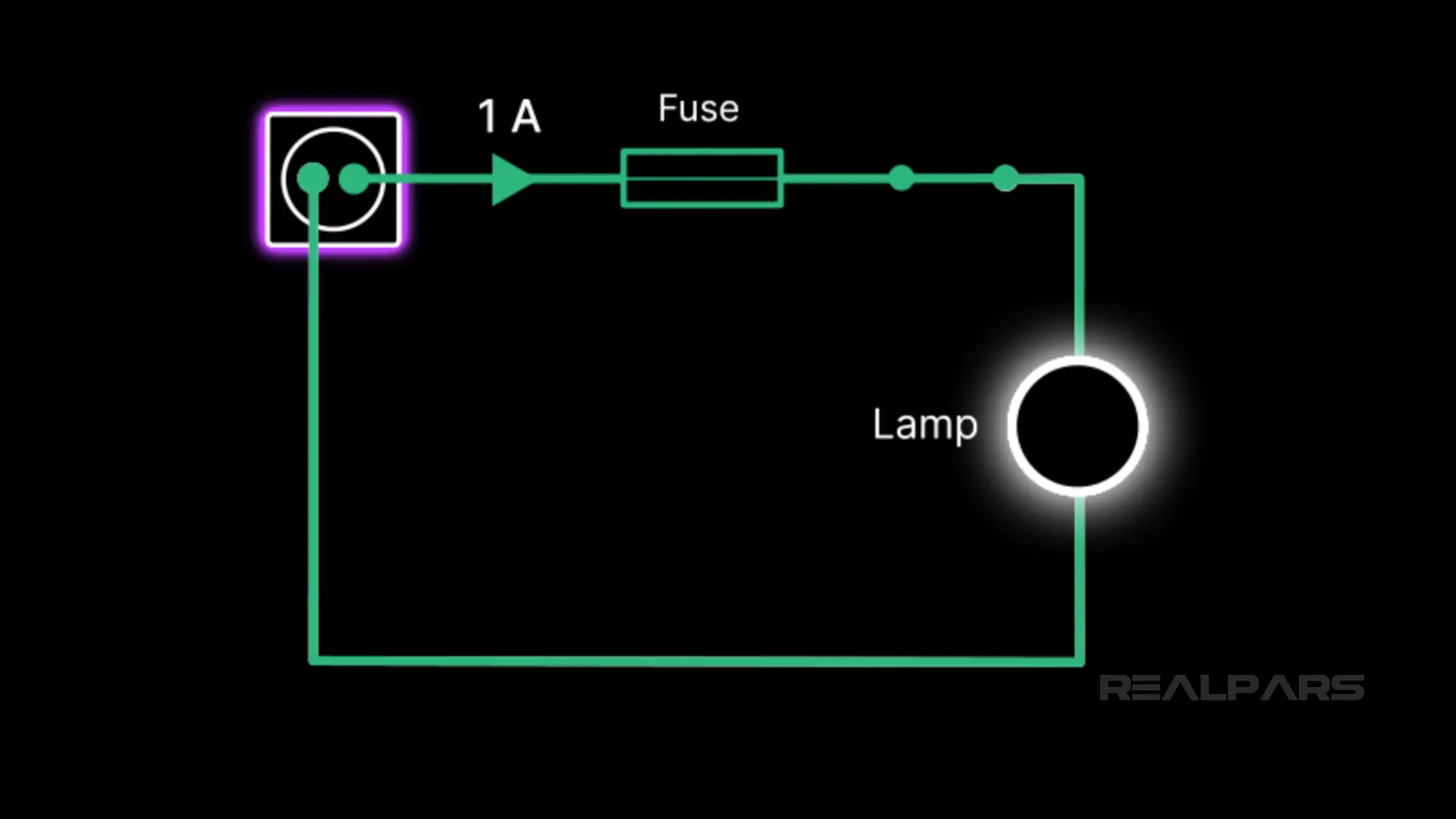
Now, if I remove this lamp, this source of control, you know what happens next, right? Yes, when the source of control is gone, the resistance goes to zero, and then the current goes to 1,000 amps range, which is what we call a short circuit.
But there is a difference this time. This time, I have a fuse here. When the fuse is here, and the current gets to a 1,000-amp range, this huge amount of current passes through the thin wire within the fuse.
As I mentioned before, high current means high temperature, so the high temperature burns the thin wire within the fuse, and when that happens, the circuit gets disconnected, and that is basically how a fuse can protect the circuit when a short circuit happens.
So you saw what happened? The lamp is removed, the source of control for the current is gone, resistance goes to zero, current spikes to 1,000 amps, but this time, since we have this fuse here, the thin wire within the fuse burns, cuts off the circuit, and cuts off the electricity.
Recap
So there you have it. Now you know what a short circuit is, how it happens, and how you can protect the circuit against a short circuit.
Thanks again for reading this article, and I’ll see you in the next article.

