
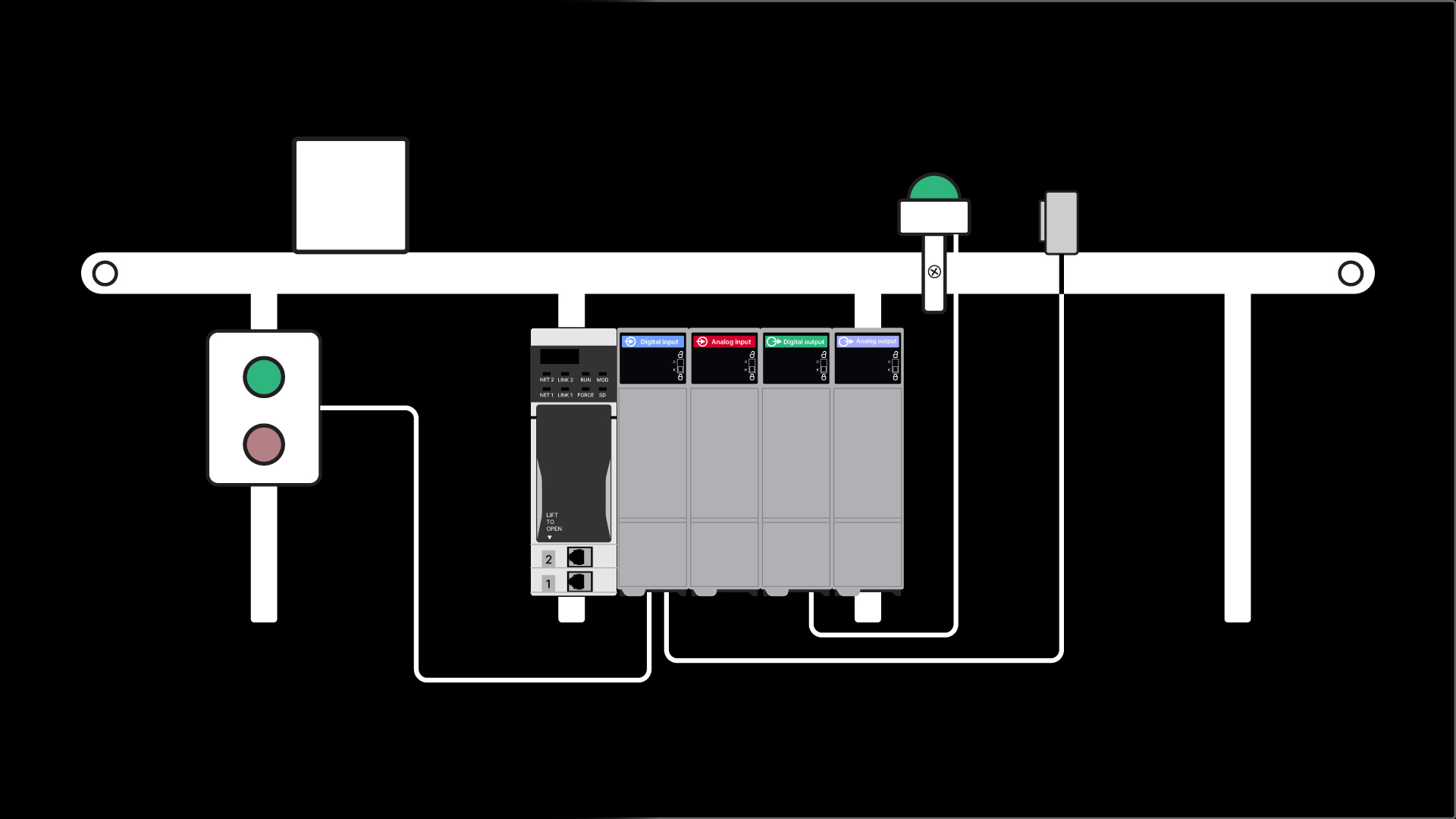
An Industrial Automation Control System, or IACS, is a set of hardware and software components that are used to manage automated processes and machinery.
In this article, I’ll introduce you to the structure of Industrial Automation Control Systems and explain how these systems are used to control processes and machinery.
Let’s get started by looking at the structure of an IACS.
Industrial Automation Control System structure
Although different industrial automation control systems may look different or be called different names, they are all made of similar components arranged in a similar architecture. An IACS is made up of:
- Input devices
- Input module
- Logic module
- Output module
- Output devices
Input devices
Input devices are sensors that detect changes in the environment and send information to the IACS as electrical signals.
There are two types of input devices - digital and analog.
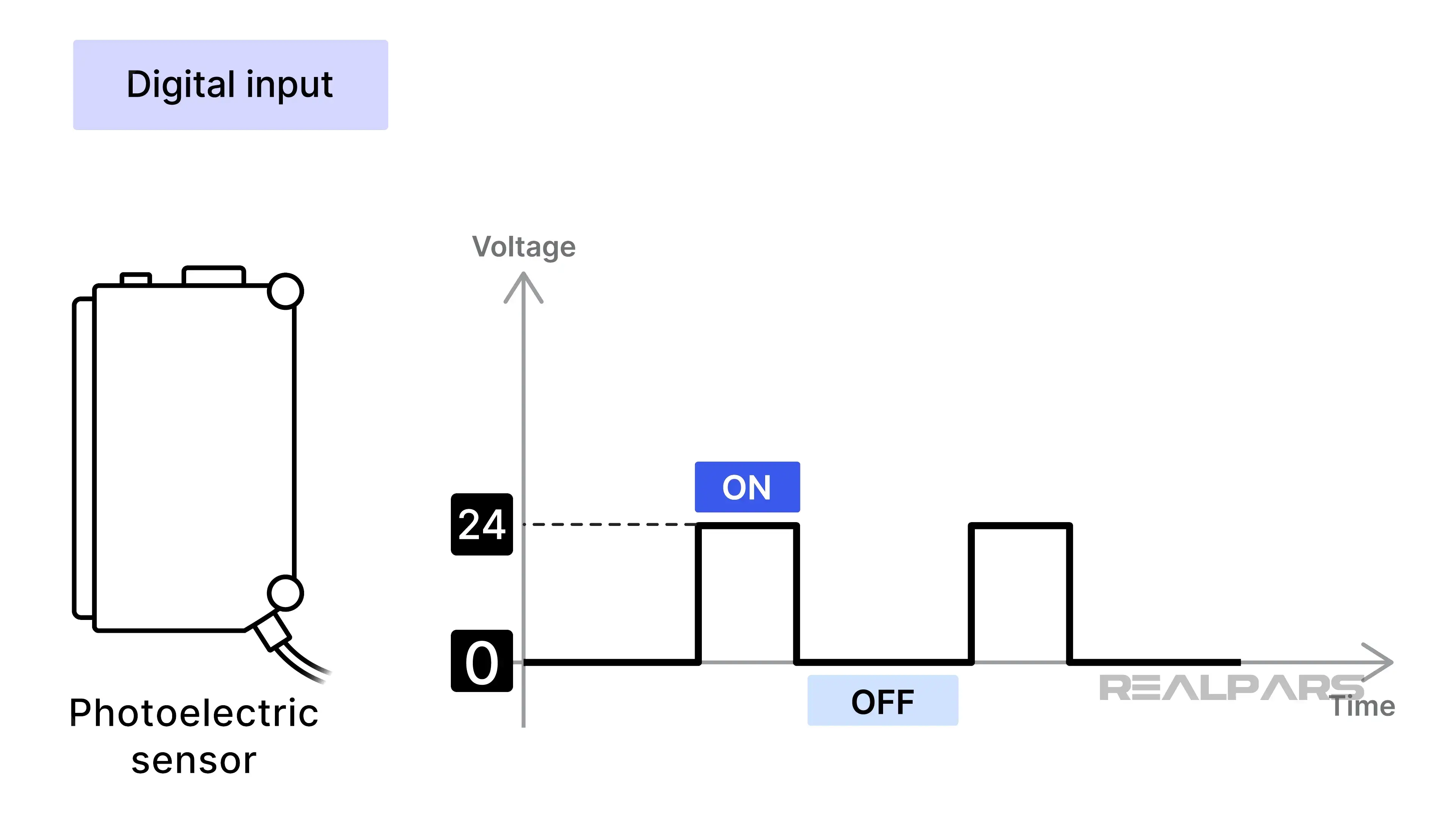
A digital input device is a device that has two states. These states are typically on and off.
Examples of digital input devices are pushbuttons, which can be pushed or not pushed, and photoelectric sensors, which can be triggered or not triggered.
Digital input devices send information to the IACS as a 0-volt or 24-volt signal to indicate if the input device is on or off.
Analog input devices can send more than two values to the control system. Typically, an analog input device sends a value to the control system that is in the range of 0 to 10 volts or 4 to 20 milliamps.

Examples of analog input devices are sensors that measure conditions like temperature sensors, pressure sensors, and humidity sensors.
Input modules
Input devices connect to a control system using input modules.
Input modules take electrical signals from input devices and convert them into digital signals that the logic module can understand.
Input modules typically convert a digital input into the values 0 and 1 and convert analog signals into a range of numbers.

Logic module
In an IACS, the most common type of logic module that you will encounter is a PLC, also known as a Programmable Logic Controller. A PLC is an industrial computer that has been hardened and adapted to control automated processes and equipment.
In an IACS, a logic module executes the same steps over and over.
First, it scans its inputs to understand the state of the process.
Then, it executes its program to determine which outputs need to be actuated.
Then, it sends commands to the output modules to control the process.
Finally, the cycle repeats.
Output modules
The logic module sends commands to an output module to control a process.
The output module takes the digital value from the logic module and converts it into an electrical signal that controls output devices. Output devices also use digital and analog signals.
Output devices
Finally, output devices are devices that have an effect on the environment and are used to control a process or piece of equipment.

Some common output devices include motors, valves, actuators, and indicator lights.
Additional components
The architecture that we have discussed so far applies to small, simple control systems.
Modern IACSes tend to be larger, more complex, and have additional components.
Let’s look at some of the additional components that you may encounter when working with IACSes.
Motor control
Many IACSes are used to control motors. These motors are used to run conveyor belts, move robotic arms, turn fans, and agitate liquid in vessels.
In simple applications, the motor is controlled using a contactor or motor starter. A contactor is effectively a big relay that the logic module can open and close using a digital output.
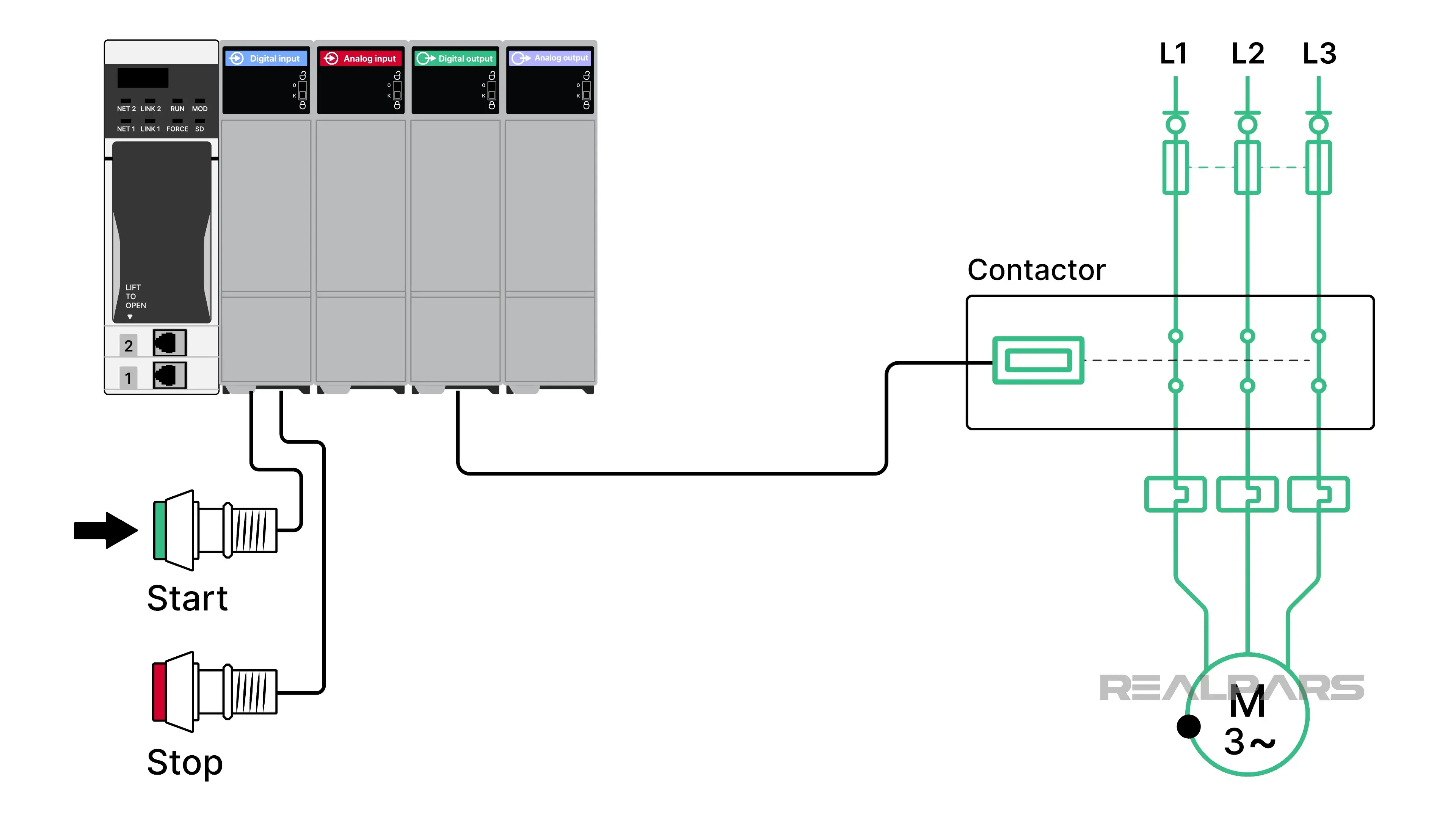
However, there is very limited control when you are using a contactor. For example, you can’t control the acceleration and deceleration of the motor, which can be important in some applications.
In applications where you want to control the motor’s acceleration, deceleration, or speed, a device called a Variable Frequency Drive or Variable Speed Drive is used. VFDs are intelligent devices that control motors by regulating their output frequency.
Typically, VFDs communicate with a PLC using an industrial network, which we will talk about shortly.
In other applications, the speed of a motor is less important than the position. For example, if you are controlling a gantry crane, the speed of the motor matters less than the position of the crane relative to the object that you want to pick up.
In applications where it is important to control the position of the motor, a device called a Servo Drive is used. These are drives that execute closed-loop control of a motor by telling the motor to move and then reading the actual position of the motor using an encoder.
Just like a VFD, servo drives typically communicate with a logic module using an industrial network.
Industrial networks
At the beginning of this article, I described an IACS where the input modules are connected directly to the logic module. But in a large IACS, there can be thousands of input and output devices that are spread over a large area. In these systems, it is very difficult to wire all of the devices back to the logic module.
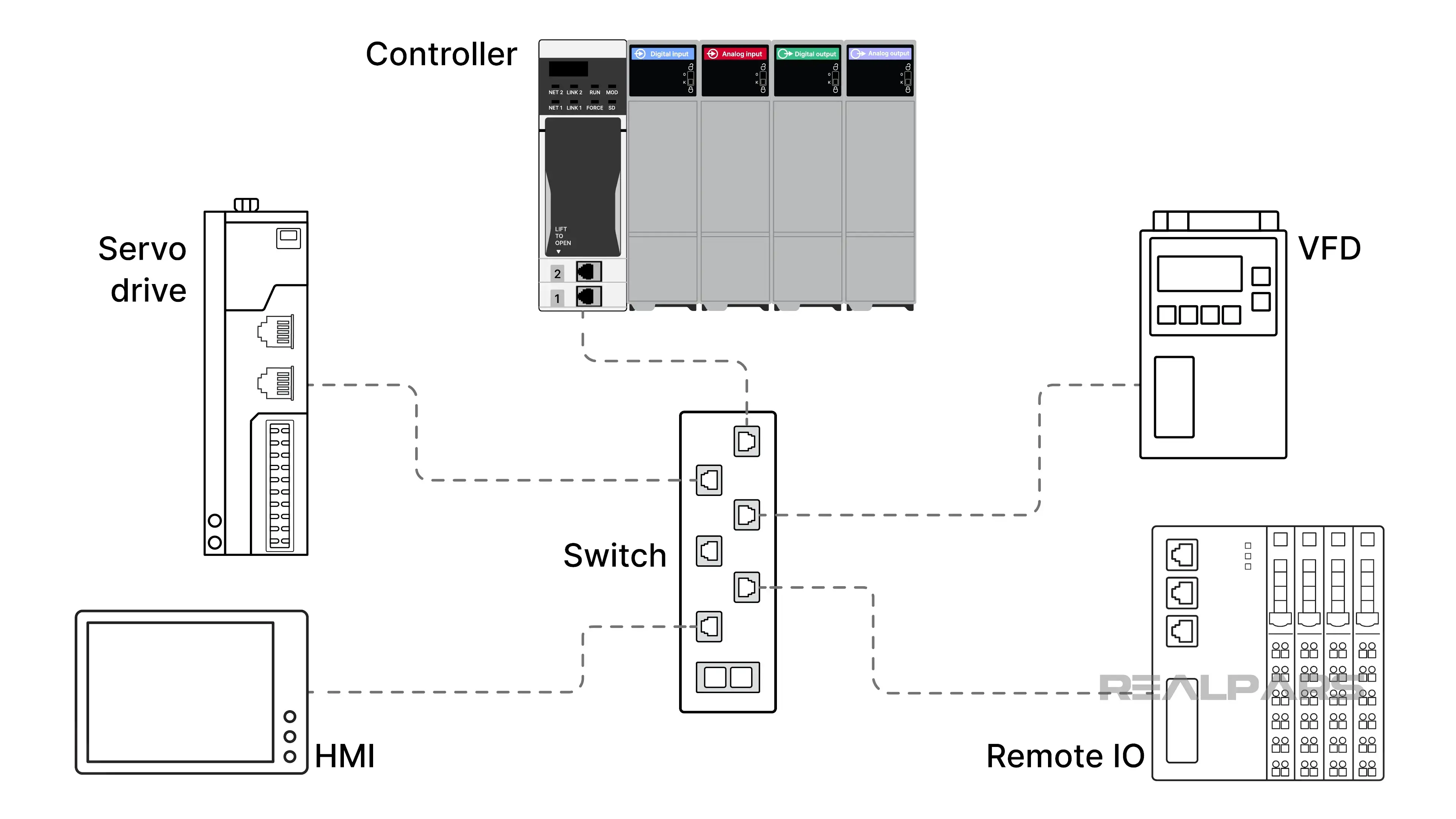
Instead, industrial networks are used to connect the logic module to remote devices like IO stations, VFDs, and servo drives.
An industrial network is a group of devices that are linked together to share data. Most common industrial networks use Ethernet cables and network switches to connect devices.
Once they are connected together on an industrial network, devices use a communication protocol to exchange data. A communication protocol is simply a set of rules that defines how communication between devices should work. Common communication protocols include Modbus TCP/IP, EtherNet/IP, and PROFINET.
Visualization
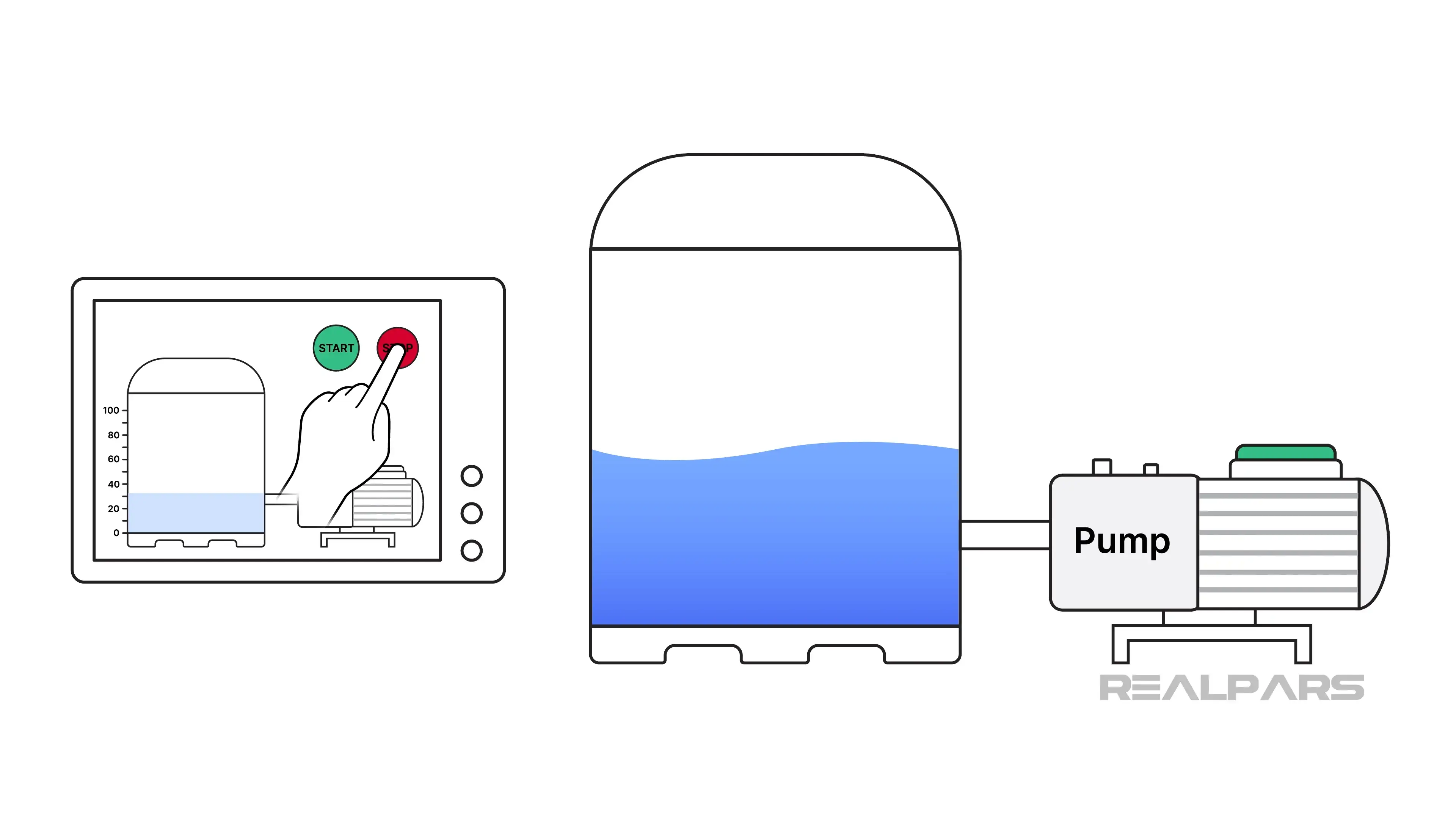
Finally, most IACSes have a way to control a process and visualize the status of the process and equipment in the IACS. This is typically done using a Human Machine Interface, also known as an HMI.
An HMI is an interface that lets a person interact with a machine.
The most simple HMIs are arrays of pushbuttons, switches, lights, and gauges. These HMIs only allow a limited amount of data to be exchanged.
Most modern machines are equipped with electronic HMIs. These are small industrial computers that can display a graphical representation of the process. Using the graphical display, operators can interact with the process by sending commands or adjusting setpoints.
Finally, most factories or plants have a site-level HMI. A site-level HMI is a supervisory HMI that aggregates data from many machines and displays them in a single view. These HMIs are typically found in a control room and are used to control full factories and production lines instead of individual machines.

Wrap-Up
Now you know what an Industrial Automation Control System is and what components make up an IACS.

